
Square Tiling Puzzle
Loading the math board and drawing, please wait…
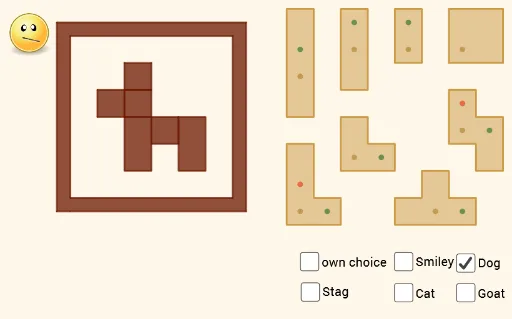
This example demonstrates the construction of complex tiling patterns using square grids, involving core mathematical concepts like plane geometry, 2D vector operations, trigonometric relationships, and coordinate geometry. Key GeoGebra commands used include Point, Polygon, Sort, Sequence, Join, If, and Rotate for creating and manipulating geometric shapes and transformations. Suitable for high school mathematics education to explore transformations and combinations of 2D shapes.
GeoGebra Commands & Parameters
Point(Circle[H1, 1]) → H2Point(Circle[I31, 1]) → I32Point(Circle[S1, 1]) → S2Point(Circle[L1, 1]) → L2Point(Circle[I21, 1]) → I22Point(Circle[I41, 1]) → I42Point(Circle[L21, 1]) → L22Point(Circle[V221, 1]) → V222Point(Circle[V211, 1]) → V212Polygon(A1, A2, A5, A3, A4, A1, A5, A6, A7, A8, A9) → Rahmen, f, p, q, g, h, i, j, k, l, m, nSort({V11, V12, V13, V14, V211, V212, V221, V222}) → SchwarzSort(Union[Union[Union[Union[Union[Union[Union[{S1, S2, S4, S3}, {L1, L2, L3}], {I21, I22}], {I31, I32, I33}], {I41, I42, I43, I44}], {Q1, Q2, Q3, Q4}], {L21, L22, L23, L24}], {H1, H2, H4, H3}]) → WeissSequence(Segment[(0.5, i), (6.5, i)], i, 1.5, 5.5, 1) → XStreckenSequence(Segment[(i, 0.5), (i, 6.5)], i, 1.5, 5.5, 1) → YStreckenJoin(Sequence[Sequence[(i, j), j, 1, 6], i, 1, 6]) → AllesSort(Union[Weiss, Schwarz]) → ZusammenIf(Zusammen ≟ Alles, 1, 0) → korrektPolygon(V12 + (0.5, 0.5), V12 + (-0.5, 0.5), V12 + (-0.5, -0.5), V12 + (0.5, -0.5)) → VielV12, r, s, t, aPolygon(V11 + (0.5, 0.5), V11 + (-0.5, 0.5), V11 + (-0.5, -0.5), V11 + (0.5, -0.5)) → VielV11, b, c, d, ePolygon(V13 + (0.5, 0.5), V13 + (-0.5, 0.5), V13 + (-0.5, -0.5), V13 + (0.5, -0.5)) → VielV13, f_1, g_1, h_1, i_1Rotate(Polygon[V211 + (-0.5, -0.5), V211 + (1.5, -0.5), V211 + (1.5, 0.5), V211 + (-0.5, 0.5)], Angle[V212 - V211], V211) → VielV21Polygon(V14 + (0.5, 0.5), V14 + (-0.5, 0.5), V14 + (-0.5, -0.5), V14 + (0.5, -0.5)) → VielV14, j_1, k_1, l_1, m_1Rotate(Polygon[V221 + (-0.5, -0.5), V221 + (1.5, -0.5), V221 + (1.5, 0.5), V221 + (-0.5, 0.5)], Angle[V222 - V221], V221) → VielV22Rotate(Polygon[I21 + (-0.5, -0.5), I21 + (1.5, -0.5), I21 + (1.5, 0.5), I21 + (-0.5, 0.5)], Angle[I22 - I21], I21) → VielI2Rotate(Polygon[I31 + (-1.5, -0.5), I31 + (1.5, -0.5), I31 + (1.5, 0.5), I31 + (-1.5, 0.5)], Angle[I32 - I31], I31) → VielI3Rotate(Polygon[I41 + (-1.5, -0.5), I41 + (2.5, -0.5), I41 + (2.5, 0.5), I41 + (-1.5, 0.5)], Angle[I42 - I41], I41) → VielI4Polygon(Q1 + (-0.5, -0.5), Q1 + (1.5, -0.5), Q1 + (1.5, 1.5), Q1 + (-0.5, 1.5)) → VielQ, n_1, p_1, q_1, r_1Rotate(Polygon[L21 + (-0.5, (-0.5 * L2x)), L21 + (1.5, (-0.5 * L2x)), L21 + (1.5, (0.5 * L2x)), L21 + (0.5, (0.5 * L2x)), L21 + (0.5, (2.5 * L2x)), L21 + (-0.5, (2.5 * L2x)), L21 + (-0.5, (0.5 * L2x))], Angle[L22 - L21], L21) → VielL2Rotate(Polygon[L1 + (-0.5, (-0.5 * Lx)), L1 + (1.5, (-0.5 * Lx)), L1 + (1.5, (0.5 * Lx)), L1 + (0.5, (0.5 * Lx)), L1 + (0.5, (1.5 * Lx)), L1 + (-0.5, (1.5 * Lx)), L1 + (-0.5, (0.5 * Lx))], Angle[L2 - L1], L1) → VielL1Rotate(Polygon[S1 + (-0.5, (-0.5 * Sx)), S1 + (0.5, (-0.5 * Sx)), S1 + (0.5, (-1.5 * Sx)), S1 + (1.5, (-1.5 * Sx)), S1 + (1.5, (-0.5 * Sx)), S1 + (1.5, (0.5 * Sx)), S1 + (0.5, (0.5 * Sx)), S1 + (0.5, (1.5 * Sx)), S1 + (-0.5, (1.5 * Sx)), S1 + (-0.5, (0.5 * Sx))], Angle[S2 - S1], S1) → VielSRotate(Polygon[H1 + (-1.5, (-0.5 * Hx)), H1 + (1.5, (-0.5 * Hx)), H1 + (1.5, (0.5 * Hx)), H1 + (0.5, (0.5 * Hx)), H1 + (0.5, (1.5 * Hx)), H1 + (-0.5, (1.5 * Hx)), H1 + (-0.5, (0.5 * Hx)), H1 + (-1.5, (0.5 * Hx))], Angle[H2 - H1], H1) → VielH