
Sphere Volume Proof by Alfred Estberg
Loading the math board and drawing, please wait…
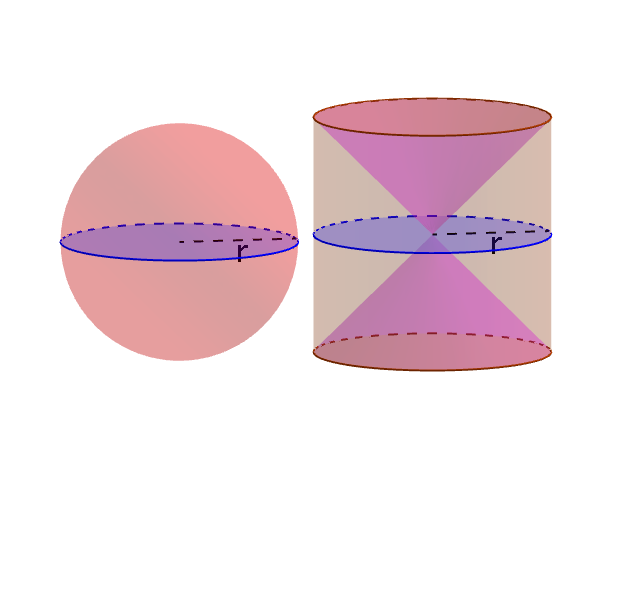
This example dynamically demonstrates the derivation of the sphere volume formula, visually showing the relationship between the sphere and the inscribed cylinder/cone in terms of volume. Core mathematical concepts include sphere, volume calculation, symmetry, fractions, polynomial functions, and division. GeoGebra commands and objects used in construction are Intersect, Point, Circle, Distance, Sphere, Cylinder, OrthogonalLine, Segment, IntersectPath, Surface, Polygon, and If. Suitable for high school students to understand the derivation of volume formulas and for mathematical teaching demonstrations.
GeoGebra Commands & Parameters
Intersect(xAxis, yAxis) → APoint(xAxis) → BCircle(A, B) → cDistance(A, B) → rPoint(xAxis) → DCircle(D, r) → hSphere(A, r) → aCylinder(h, r) → b, d, eCylinder(h, (-r)) → f, g, iPoint(xAxis) → COrthogonalLine(C, xOyPlane) → jSegment(E, C) → kPoint(k) → GIntersectPath(l, a) → pIntersectPath(l, b) → qSurface((u * cos(θ)) + Distance[A, D], (u * sin(θ)), u, θ, 0, 6.283185307179586, u, (-r), r) → mIntersectPath(l, f) → sOrthogonalLine(D, l) → nSurface(x(H) + (u * cos(θ)), (u * sin(θ)), z(G), u, z(G), r, θ, 0, 6.283185307179586) → oSegment(A, B) → tIntersect(h, xAxis, 2) → JSegment(D, J) → a_1Segment(A, I) → b_1Segment(D, H) → c_1Intersect(u, p) → K, LSegment(I, L) → d_1Segment(A, L) → e_1Segment(H, N) → f_1Segment(C, G) → g_1Segment(A, L) → h_1Polygon(A, I, L) → poly1, l_1, a_2, i_1Segment(S, R) → j_1Polygon(S, R, D) → poly2, d_2, s_1, r_1Segment(D, S) → k_1If(Step ≠ 10, Step ≟ Step + 1, Step ≟ 0) → vIf(Step ≠ 10, Step ≟ Step + 1, Step ≟ 0) → wIf(Step ≠ 10, Step ≟ Step + 1, Step ≟ 0) → m_1If(Step ≠ 10, Step ≟ Step + 1, Step ≟ 0) → n_1If(Step ≠ 10, Step ≟ Step + 1, Step ≟ 0) → o_1If(Step ≠ 10, Step ≟ Step + 1, Step ≟ 0) → p_1
AI Drawing Prompt Reference
Draw a sphere with center A and radius r. Inside the sphere, draw a cylinder and a cone, where the cylinder's base diameter equals the sphere's diameter and its height equals the sphere's diameter; the cone's base diameter also equals the sphere's diameter and its height equals half the sphere's diameter. Use rotation and slicing to demonstrate the derivation of the sphere's volume formula.
The prompt above was compiled from the original drawing commands and is for reference only.