
Sphere and Geometric Transformations
Loading the math board and drawing, please wait…
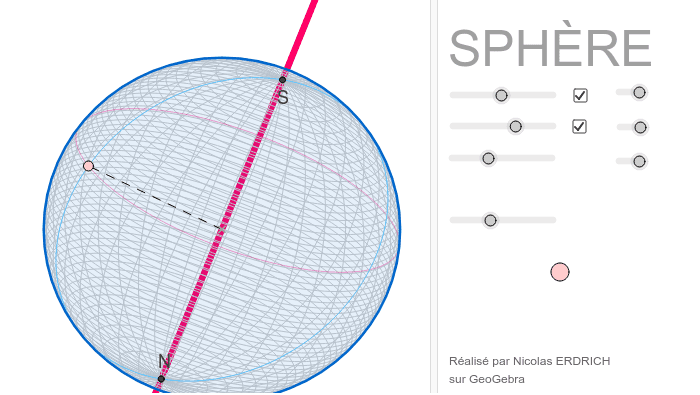
This example demonstrates the geometric construction and transformations of a sphere, including rotation, reflection, and scaling. It involves core mathematical concepts such as solid geometry, trigonometry, transformation matrices, and parametric equations. GeoGebra commands like Sequence, Conic, Segment, Translate, Point, Dilate, Mirror, Circle, and Line are used in the construction. Suitable for high school and above students learning spatial geometry, transformation theory, and applications of parametric equations.
GeoGebra Commands & Parameters
Sequence(Mat * Element[cercle1, k], k, 1, 5) → cercle1'Sequence((Element[cercle1', k, 1, 1], Element[cercle1', k, 2, 1]), k, 1, 5) → points_1Conic(Element[points_1, 1], Element[points_1, 2], Element[points_1, 3], Element[points_1, 4], Element[points_1, 5]) → c_1Sequence(Mat * Element[cercle2, k], k, 1, 5) → cercle2'Sequence((Element[cercle2', k, 1, 1], Element[cercle2', k, 2, 1]), k, 1, 5) → points_2Conic(Element[points_2, 1], Element[points_2, 2], Element[points_2, 3], Element[points_2, 4], Element[points_2, 5]) → c_2Sequence(Mat * Element[cercle3, k], k, 1, 5) → cercle3'Sequence((Element[cercle3', k, 1, 1], Element[cercle3', k, 2, 1]), k, 1, 5) → points_3Conic(Element[points_3, 1], Element[points_3, 2], Element[points_3, 3], Element[points_3, 4], Element[points_3, 5]) → c_3Sequence(Mat * Element[anneau1, k], k, 1, 5) → anneau1'Sequence((Element[anneau1', k, 1, 1], Element[anneau1', k, 2, 1]), k, 1, 5) → pointsConic(Element[points, 1], Element[points, 2], Element[points, 3], Element[points, 4], Element[points, 5]) → cSegment(O, N) → rayonTranslate(O, O - N) → SSequence(Translate[Dilate[c_1, sqrt(1 - (k / n)^(2)), O], k / n * (N - O)], k, -n, n) → cerclesSequence({{cos(k * 180 * ° / v)}, {sin(k * 180 * ° / v)}, {0}}, k, 0, v) → tourSequence(Mat * Element[tour, k], k, 1, v) → tour'Sequence((Element[tour', k, 1, 1], Element[tour', k, 2, 1]), k, 1, v) → Passage1Sequence(Translate[Dilate[Element[Passage1, k], 0.9797958971132712, O], 0.2 * (N - O)], k, 1, v) → passage2Sequence(Translate[Dilate[Element[Passage1, k], 0.916515138991168, O], 0.4 * (N - O)], k, 1, v) → passage3Sequence(Conic[N, S, Element[Passage1, k], Element[passage3, k], Element[passage2, k]], k, 1, v) → méridiensPoint(c) → BDilate(Translate[B, -u * (N - O)], 1 / sqrt(1 - u^(2)), O) → B'Mirror(B', O) → B''Conic(N, S, B, B', B'') → eSegment(O, B) → bSegment(O, B') → gCircle(O, a) → fLine(S, N) → h
AI Drawing Prompt Reference
Draw a sphere to demonstrate its geometric transformations, including rotation, reflection, and scaling. Begin by constructing the sphere's basic geometry, such as sequences of points on the sphere's surface, and then create cross-sections of the sphere using these points. Next, apply a series of transformations like rotation, reflection, and scaling to the sphere, using different colors and line styles to distinguish the original and transformed parts. Finally, add auxiliary line segments and circles to highlight the sphere's geometric properties and transformation relationships, enhancing the spatial perception and educational value of the illustration.
The prompt above was compiled from the original drawing commands and is for reference only.