
Specifying Fractions through Comparisons
Loading the math board and drawing, please wait…
In collections
Zahlenstrahl und Ordnen von Brüchen
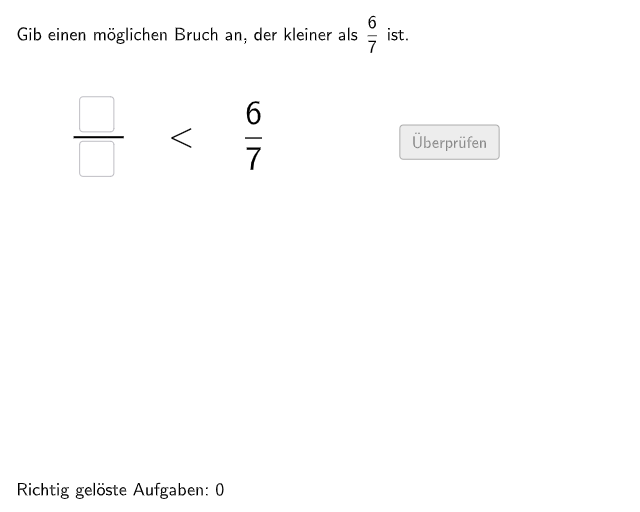
① This interactive GeoGebra exercise helps students understand fractions by comparing their sizesholistically. ② Core math concepts include fraction meaning, comparison (greater than, less than, equal), and interpreting fractions as relative parts. ③ Construction uses GeoGebra commands such as Shuffle, Numerator, Denominator, If, Textfield, Polygon, Element, Append, Remove, Defined, Length, Sequence, Segment, and Unique to create a dynamic interface that randomly generates fraction comparison tasks, with input boxes, validation buttons, hints, and answer display. ④ Suitable for grades 5-6, this material serves as classroom practice or homework to reinforce fraction sense and comparison skills.
GeoGebra Commands & Parameters
Shuffle(Unique[Sort[Join[Sequence[Sequence[j / k, j, 1, k], k, 2, 13]] \ {1}]]) → listMöglicheBrüche, {0.15384615384615385, 0.2222222222222222, 0.8461538461538461, 0.8, 0.07692307692307693, 0.16666666666666666, 0.1111111111111111, 0.6923076923076923, 0.3333333333333333, 0.09090909090909091, 0.6153846153846154, 0.8333333333333334, 0.7142857142857143, 0.2857142857142857, 0.14285714285714285, 0.4444444444444444, 0.5714285714285714, 0.7272727272727273, 0.375, 0.8571428571428571, 0.36363636363636365, 0.8181818181818182, 0.5454545454545454, 0.3, 0.45454545454545453, 0.5833333333333334, 0.5555555555555556, 0.08333333333333333, 0.42857142857142855, 0.25, 0.38461538461538464, 0.7777777777777778, 0.2, 0.9, 0.75, 0.23076923076923078, 0.5384615384615384, 0.9230769230769231, 0.625, 0.9090909090909091, 0.8888888888888888, 0.125, 0.6363636363636364, 0.46153846153846156, 0.5, 0.6666666666666666, 0.7, 0.4166666666666667, 0.18181818181818182, 0.6, 0.7692307692307693, 0.4, 0.1, 0.3076923076923077, 0.875, 0.2727272727272727, 0.9166666666666666}Shuffle(Sequence[i, i, 2, Length[listMöglicheBrüche], 1]) → ZZList, {20, 36, 53, 51, 17, 27, 11, 38, 7, 41, 52, 5, 54, 18, 50, 55, 30, 46, 48, 56, 15, 8, 43, 3, 10, 45, 23, 14, 21, 29, 57, 24, 16, 22, 12, 26, 35, 44, 4, 49, 47, 6, 42, 25, 33, 37, 9, 40, 32, 13, 31, 19, 28, 39, 34, 2}Denominator(listMöglicheBrüche(AuswahlZZ)) → NennerNumerator(listMöglicheBrüche(AuswahlZZ)) → ZählerShuffle({"<", ">", "<", ">"}) → listMöglicheZeichen, {"<", ">", ">", "<"}Shuffle({1, 2}) → listMöglicheFälle, {2, 1}Shuffle({0.5, 0.75, 1}) → listMöglicheBrücheGleich, {0.75, 0.5, 1}If(correctGrößer, Numerator[listMöglicheBrüche(AuswahlZZ + 1)], If[correctKleiner, Numerator[listMöglicheBrüche(AuswahlZZ - 1)], If[correctGleich ∧ AuswahlGleich ≟ 1, 1, If[correctGleich ∧ AuswahlGleich ≟ 0.75, 3, 1]]]) → ZählerLösungIf(correctGrößer, Denominator[listMöglicheBrüche(AuswahlZZ + 1)], If[correctKleiner, Denominator[listMöglicheBrüche(AuswahlZZ - 1)], If[correctGleich ∧ AuswahlGleich ≟ 1, 1, If[correctGleich ∧ AuswahlGleich ≟ 0.75, 4, 2]]]) → NennerLösungTextfield(aInput) → InputBox1Textfield(bInput) → InputBox2Polygon(PtopLeftCornerFeedback, PtopRightCornerFeedback, PbottomRightCornerFeedback, PbottomLeftCornerFeedback) → rectangleCorrect, ptopleftcornerfeedback, ptoprightcornerfeedback, pbottomrightcornerfeedback, pbottomleftcornerfeedbackShuffle(Sequence[Random[0, 10], i, 1, 100]) → randomNosForX, {4, 3, 7, 7, 1, 8, 8, 10, 3, 10, 0, 7, 6, 5, 3, 9, 10, 10, 10, 2, 1, 6, 7, 8, 5, 7, 3, 8, 10, 5, 0, 5, 2, 7, 0, 2, 7, 3, 1, 10, 8, 7, 0, 7, 0, 9, 6, 8, 10, 5, 10, 8, 8, 3, 3, 2, 10, 3, 1, 8, 1, 5, 0, 8, 2, 2, 0, 8, 5, 0, 0, 1, 7, 6, 4, 3, 6, 7, 6, 7, 2, 7, 5, 6, 5, 9, 5, 10, 10, 3, 2, 4, 2, 7, 6, 6, 9, 4, 9, 6}Element(randomNosForX, Mod[questionCount, 100] + 1) → numXShuffle(Sequence[Random[0, 10], i, 1, 100]) → randomNosForY, {3, 10, 1, 5, 3, 0, 1, 4, 4, 9, 3, 6, 1, 1, 2, 8, 8, 10, 6, 0, 2, 0, 4, 4, 4, 9, 7, 3, 10, 0, 3, 5, 0, 8, 6, 6, 10, 1, 0, 2, 10, 6, 8, 2, 5, 5, 2, 4, 6, 9, 7, 10, 6, 1, 10, 3, 0, 10, 9, 3, 5, 0, 9, 9, 7, 2, 7, 5, 2, 6, 8, 6, 2, 0, 6, 2, 6, 7, 5, 6, 2, 2, 9, 5, 2, 2, 8, 2, 2, 9, 9, 8, 9, 9, 0, 2, 3, 0, 8, 10}Element(randomNosForY, Mod[questionCount, 100] + 1) → numYAppend(true, Sequence[If[randomNosForX(i) ≟ randomNosForX(i - 1), false, true], i, 2, 100]) → stayXAppend(true, Sequence[If[randomNosForY(i) ≟ randomNosForY(i - 1), false, true], i, 2, 100]) → stayYRemove(Sequence[If[stayX(i), randomNosForX(i), 0], i, 1, 100], Sequence[0, i, 1, 100]) → randomNosForXwithoutRepeatRemove(Sequence[If[stayY(i), randomNosForY(i), 0], i, 1, 100], Sequence[0, i, 1, 100]) → randomNosForYwithoutRepeatElement(randomNosForXwithoutRepeat, Mod[questionCount, Length[randomNosForXwithoutRepeat]] + 1) → numXwithoutRepeatElement(randomNosForYwithoutRepeat, Mod[questionCount, Length[randomNosForYwithoutRepeat]] + 1) → numYwithoutRepeatDefined((aInput * bInput)) → fixedLength(listMöglicheBrüche) → LängeListeSequence((1 + (k * Distance[E4BAngabe, E3BAngabe] / If[correctGleich ∧ AuswahlGleich ≟ 1, 1, If[correctGleich ∧ AuswahlGleich ≟ 0.5, 2, If[correctGleich ∧ AuswahlGleich ≟ 0.75, 4, If[¬correctGleich, Nenner]]]]), y(E3BAngabe)), k, 0, If[correctGleich ∧ AuswahlGleich ≟ 1, 1, If[correctGleich ∧ AuswahlGleich ≟ 0.5, 2, If[correctGleich ∧ AuswahlGleich ≟ 0.75, 4, If[¬correctGleich, Nenner]]]]) → PBAngabeObenSequence((1 + (i * Distance[E1BAngabe, E2BAngabe] / If[correctGleich ∧ AuswahlGleich ≟ 1, 1, If[correctGleich ∧ AuswahlGleich ≟ 0.5, 2, If[correctGleich ∧ AuswahlGleich ≟ 0.75, 4, If[¬correctGleich, Nenner]]]]), y(E1BAngabe)), i, 0, If[correctGleich ∧ AuswahlGleich ≟ 1, 1, If[correctGleich ∧ AuswahlGleich ≟ 0.5, 2, If[correctGleich ∧ AuswahlGleich ≟ 0.75, 4, If[¬correctGleich, Nenner]]]]) → PBAngabeUntenSequence(Segment[PBAngabeOben(i), PBAngabeUnten(i)], i, 1, Nenner + 1) → BAngabeBalkenSegment(E4BAngabe, E3BAngabe) → BAngabeStreckeObenSegment(E1BAngabe, E2BAngabe) → BAngabeStreckeUntenSegment(E4BInput, E3BInput) → BInputStreckeObenSegment(E1BInput, E2BInput) → BInputStreckeUntenSequence((1 + (k * Distance[E4BInput, E3BInput] / NennerSchieberegler), y(E3BInput)), k, 0, NennerSchieberegler) → PBInputObenSequence((1 + (k * Distance[E1BInput, E2BInput] / NennerSchieberegler), y(E1BInput)), k, 0, NennerSchieberegler) → PBInputUntenSequence(Segment[PBInputOben(i), PBInputUnten(i)], i, 1, NennerSchieberegler + 1) → BInputBalkenSequence(Polygon[PBInputUnten(i), PBInputUnten(i + 1), PBInputOben(i + 1), PBInputOben(i)], i, 1, ZählerSchieberegler) → BInputFlächenUnique(Sort[Join[Sequence[Sequence[j / k, j, 1, k], k, 2, 13]]]) → listMöglicheBrüche_{1}Length(listMöglicheBrüche_{1}) → LängeListe_{1}Sequence(Polygon[PBAngabeUnten(i), PBAngabeUnten(i + 1), PBAngabeOben(i + 1), PBAngabeOben(i)], i, 1, If[¬correctGleich, Zähler, If[correctGleich ∧ AuswahlGleich ≟ 0.75, 3, If[correctGleich ∧ AuswahlGleich ≟ 0.5, 1, If[correctGleich ∧ AuswahlGleich ≟ 1, Nenner]]]]) → BAngabeFlächen
AI Drawing Prompt Reference
Create a dynamic illustration showing fraction comparisons. Randomly generate two fractions, represent them with polygons of different sizes, and label their values. Provide input boxes for users to enter comparison results (greater than, less than, or equal), and display the correct answer. The graphic should include fraction representations, comparison symbols, user input fields, and answer feedback, designed to be intuitive and suitable for elementary students understanding fraction comparisons.
The prompt above was compiled from the original drawing commands and is for reference only.