
Special Points of a Triangle
Loading the math board and drawing, please wait…
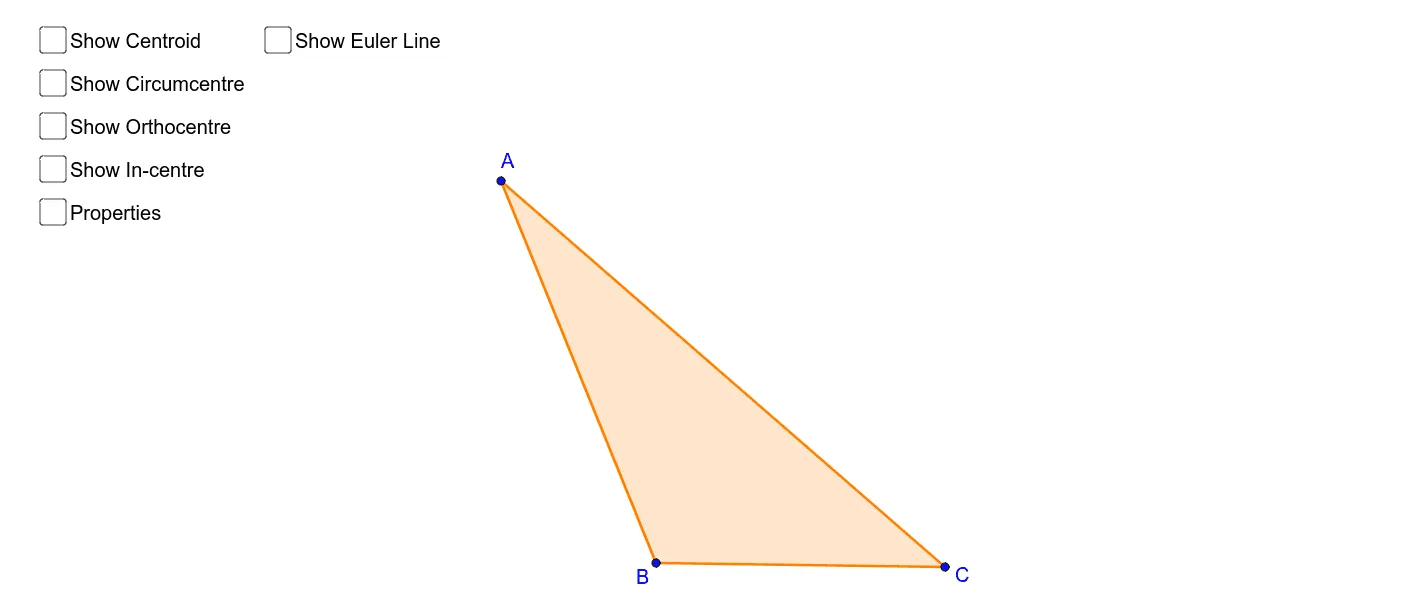
This example illustrates several special points of a triangle, including the centroid, circumcenter, incenter, and orthocenter. Using GeoGebra commands such as Polygon, LineBisector, and Intersect, the properties and positions of these points are demonstrated. Suitable for middle and high school students learning geometric construction and related concepts.
GeoGebra Commands & Parameters
Polygon(A, B, C) → poly1, c, a, bLineBisector(c) → dLineBisector(b) → eLineBisector(a) → fIntersect(d, e) → OAngularBisector(A, C, B) → gAngularBisector(B, A, C) → hAngularBisector(C, B, A) → iIntersect(g, h) → IMidpoint(a) → FMidpoint(c) → G_1Midpoint(b) → H_1Line(G_1, C) → jLine(H_1, B) → kLine(A, F) → lIntersect(j, k) → GOrthogonalLine(A, a) → mOrthogonalLine(C, c) → nOrthogonalLine(B, b) → pIntersect(m, n) → HCircle(O, A) → rDistance(I, b) → distanceEbCircle(I, distanceEb) → sIntersect(f, a) → KIntersect(d, c) → LIntersect(e, b) → MAngle(O, K, B) → αAngle(O, M, C) → βAngle(O, L, A) → γLine(A, C) → qLine(C, B) → tLine(B, A) → a_1Intersect(p, q) → NIntersect(n, a_1) → PIntersect(m, t) → QAngle(H, N, C) → δAngle(H, Q, B) → εAngle(H, P, A) → ζAngle(B, C, I) → ηAngle(I, C, A) → θAngle(C, A, I) → ιAngle(I, A, B) → κAngle(A, B, I) → λAngle(I, B, C) → μPolygon(Q, N, P) → poly2, p_1, q_1, n_1Distance(H, p_1) → distanceJp1Intersect(l, a) → RIntersect(k, b) → SIntersect(j, c) → TSegment(C, R) → b_1Segment(R, B) → d_1Segment(B, T) → e_1Segment(T, A) → f_1Segment(A, S) → g_1Segment(S, C) → h_1Segment(A, G) → i_1Segment(G, F) → j_1Segment(H_1, G) → k_1Segment(G, B) → l_1Segment(G_1, G) → m_1Segment(G, C) → r_1OrthogonalLine(H, p_1) → c_1Intersect(c_1, p_1) → DCircle(H, D) → s_1Segment(H, O) → t_1
AI Drawing Prompt Reference
Draw a triangle ABC and find its circumcenter O, incenter I, centroid F, and orthocenter H. Use midpoints and angle bisectors to locate F, I, and H. Draw a circle with O and A, and another circle with I and the distance to a side. Use angle bisectors and perpendicular lines to find feet K, L, M, and angles α, β, γ. Finally, draw altitudes from H to find feet N, P, Q, and angles δ, ε, ζ.
The prompt above was compiled from the original drawing commands and is for reference only.