
Solving One-Variable Linear Equations
Loading the math board and drawing, please wait…
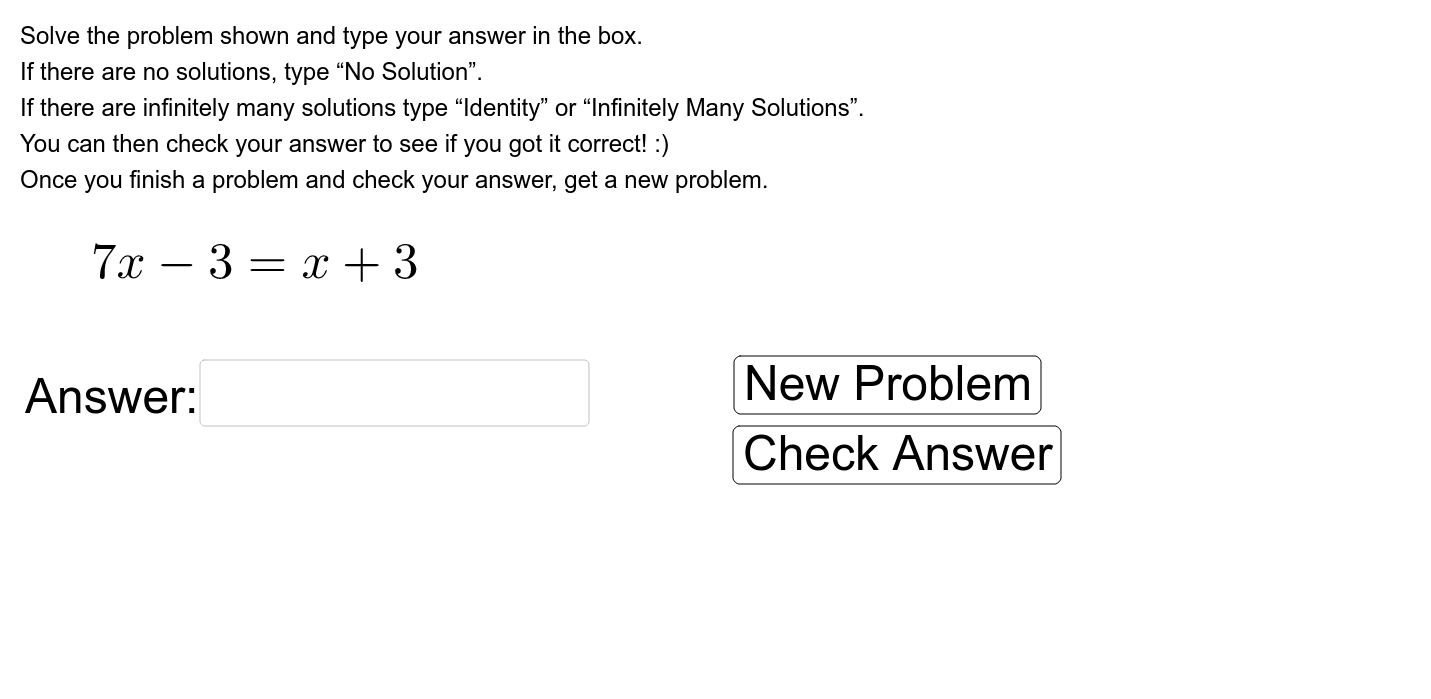
This example randomly generates one-variable linear equations to demonstrate the solutions, including unique solutions, no solutions, and infinitely many solutions. Using GeoGebra commands like If, Remove, RandomElement, it dynamically generates equations and shows solution methods. Suitable for middle school and above students to learn one-variable linear equation solving.
GeoGebra Commands & Parameters
If(problemCount < 10, 0.5, If[problemCount < 20, 0.8, If[problemCount < 30, 1, If[problemCount < 40, 1.2, 1.5]]]) → rangeMultiplierIf(SelectedElement[numberChoices] ≟ "All", RandomElement[numberOptions], SelectedElement[numberChoices]) → numberTypeIf(numberType ≟ "Integer", 1, RandomElement[factorList]) → factor_1Remove(factorList, {factor_1}) → factorList_2If(numberType ≟ "Integer", 1, RandomElement[factorList_2]) → factor_2Remove(factorList_2, {factor_2}) → factorList_3If(numberType ≟ "Integer", 1, RandomElement[factorList_3]) → factor_3If(SelectedElement[answerChoices] ≟ "All", RandomElement[answerOptions], SelectedElement[answerChoices]) → answerTypeIf(answerType ≟ "Many", seed_b, round(Random[(-1000 * rangeMultiplier), (1000 * rangeMultiplier)] / If[numberType ≟ "Integer", 50, If[numberType ≟ "Fraction", 100, 1]]) / If[numberType ≟ "Decimal", (2^(Random[1, 2]) * 5^(Random[1, 2])), 1]) → seed_dRandomElement({0, 0, 0, 1}) → leftDistributionIf(answerType ≠ "One", seed_a, round(Random[(-1000 * rangeMultiplier), (1000 * rangeMultiplier)] / If[numberType ≟ "Integer", 50, If[numberType ≟ "Fraction", 100, 1]]) / If[numberType ≟ "Decimal", (2^(Random[1, 2]) * 5^(Random[1, 2])), 1]) → seed_cRandomElement({0, 0, 0, 1}) → rightDistributionIf(seed_a ≟ 0, 1, seed_a) → aIf(solutionText ≟ "Infinitely Many Solutions", "Identity", If[solutionText ≟ "No Solution", "no solution", solutionText]) → solutionAlternativeRandomElement(factorList_4) → den_aRandomElement(factorList_4) → den_bRandomElement(factorList_4) → den_cIf(numberType ≟ "Decimal", "" + display_a, FractionText[display_a / commonDenominator]) → aTextIf(numberType ≟ "Decimal", "" + (If[display_b < 0, (-display_b), display_b]), If[display_b < 0, FractionText[((-display_b)) / commonDenominator], FractionText[display_b / commonDenominator]]) → bTextIf(numberType ≟ "Decimal", "" + display_c, FractionText[display_c / commonDenominator]) → cTextIf(numberType ≟ "Decimal", "" + (If[display_d < 0, (-display_d), display_d]), If[display_d > 0, FractionText[display_d / commonDenominator], FractionText[((-display_d)) / commonDenominator]]) → dTextRandomElement(factorList_4) → den_dTextfield(enteredAnswer) → AnswerBox
AI Drawing Prompt Reference
Create a graphical representation of a one-variable linear equation, including coefficients in integer, fraction, and decimal forms. Randomly generate the equation and show the solution scenarios, including unique solutions, no solutions, and infinitely many solutions. The equation format is ax + b = cx + d, where a, b, c, and d are randomly generated integers, fractions, or decimals.
The prompt above was compiled from the original drawing commands and is for reference only.