
Snell's Law Demonstration by Ryan Hirst
Loading the math board and drawing, please wait…
In collections
Light
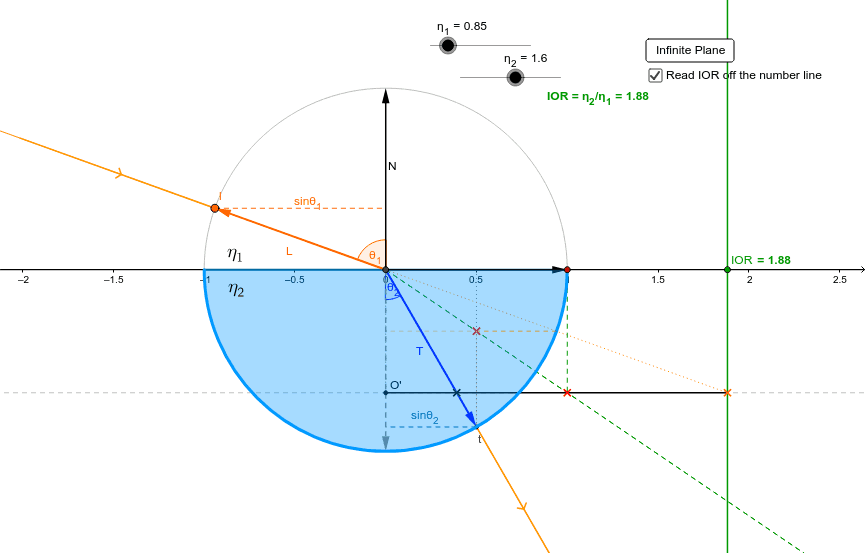
This example demonstrates the refraction of light passing through different media. Key mathematical concepts include Snell's Law, angle of incidence, angle of refraction, and index of refraction. Construction involves Geogebra commands such as Intersect, Circle, Point, Vector, Line, UnitOrthogonalVector, Translate, Ray, Segment, and CircleArc to model the phenomenon. Suitable for high school physics and mathematics education to understand the principles of light refraction and calculations.
GeoGebra Commands & Parameters
Intersect(xAxis, yAxis) → OCircle(O, 1) → cPoint(c) → lPoint(c, 0.5) → uVector(O, u) → ULine(l', U) → p_1UnitOrthogonalVector(U) → NVector(O, l) → LPoint(O, T) → tLine(O, u) → f_1Line(t, N) → m_1Translate(O, Vector[SideL * u, M']) → O'Point(O, N) → n_2If(rotSin > 0, 1, -1) → σRay(O, l') → dRay(O, t) → eSegment(t, -(T * (-N)) * n_2) → hLine(O', M') → qIntersect(q, d) → L'Intersect(q, e) → t'CircleArc(O, B, u) → r_1Segment(u, B) → a_1Line(L', N) → b_1If(abs(rotCos) > 0.001, true, false) → wSegment(O', M') → g_1Segment(M', L') → h_1Segment(t, Intersect[m_1, f_1]) → txSegment(l', Intersect[p_1, Line[O, N]]) → k_1Intersect(k_1, tx) → ESegment(O, L') → jSegment(O, O') → pAngle(T, Vector[-UpL * N]) → θ_2Angle(L, Vector[UpL * N]) → θ_1Ray(O, R) → iSegment(l, L * N * n_2) → gRay(O, l) → bPoint(b) → APoint(O, Vector[2 * T]) → CSegment(A, l) → sSegment(t, C) → j_1Point(O, Vector[2 * R]) → DSegment(r, D) → l_1Intersect(c, r_1, 1) → GIntersect(c, r_1, 1) → IIntersect(c, r_1) → J, , ,If(UpL ≟ 1, true, false) → TopAngle(Vector[-N], R) → αSegment(SideL * u, M') → fRay(O, E) → nLine(l', N) → c_1Intersect(b_1, f_1) → IORDistance(O, I) → OIIf(z > 0, If[N * L > 0, η_2 / η_1, η_1 / η_2], "Total Internal Refraction") → n_1Intersect(m_1, p_1) → FSegment(F, t) → q_1Segment(l', F) → s_1Ray(O, F) → t_1
AI Drawing Prompt Reference
Draw a diagram demonstrating the refraction of light, including a circle and two lines, one tangent to the circle and the other intersecting the circle at the origin, showing the angle of incidence and refraction, with vectors indicating the direction of light and the normal direction, labeling the index of refraction and angle values, using a slider to adjust the angle of incidence and refraction to show the changes in refraction.
The prompt above was compiled from the original drawing commands and is for reference only.