
Slope Compensation in Current Mode Controller
Loading the math board and drawing, please wait…
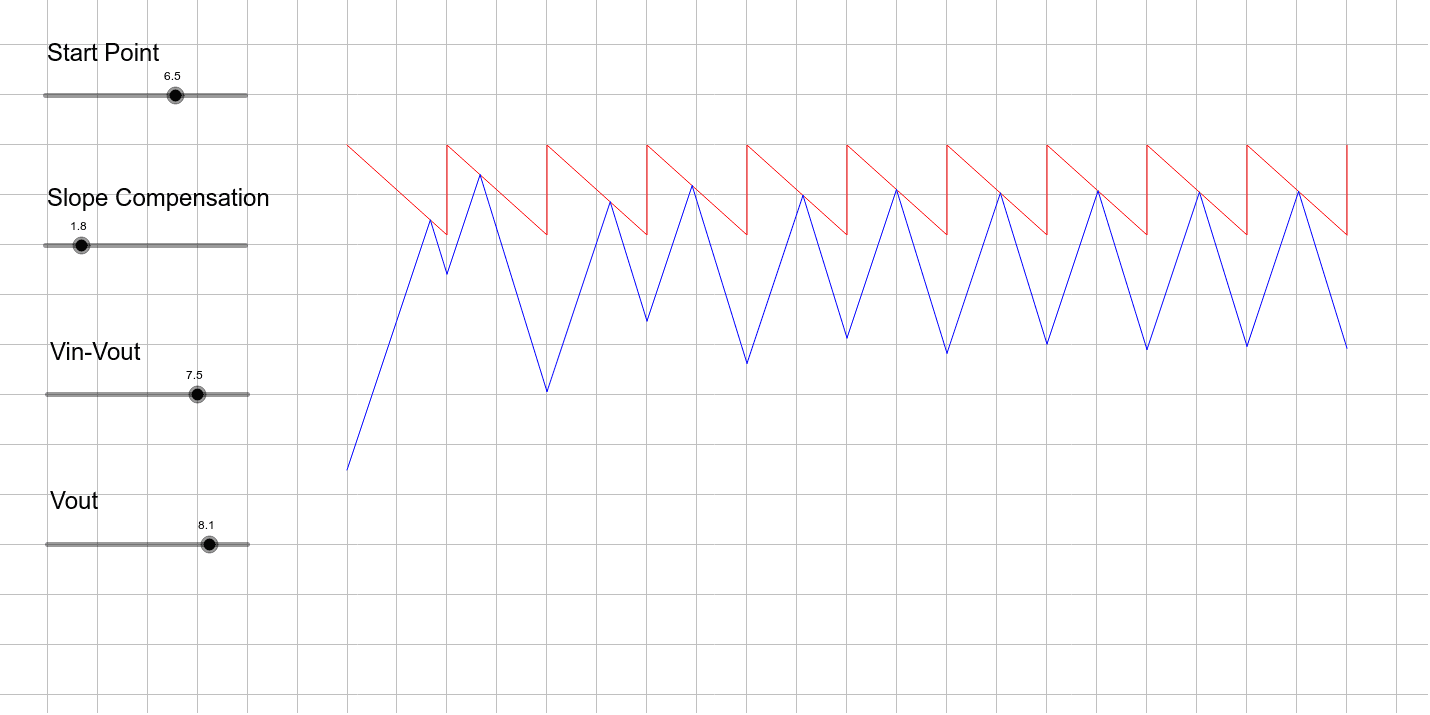
This example illustrates the principle of slope compensation in current mode controllers. Key mathematical concepts include linear relationships and proportions. Using GeoGebra commands such as Point, Segment, Line, PolyLine, and Intersect, a geometric model of slope compensation is constructed. Suitable for learners in electrical engineering and control theory.
GeoGebra Commands & Parameters
Point(yAxis) → ASegment(A, B) → aPoint(a) → CSegment(C, D) → bPoint(yAxis) → ESegment(E, F) → cPoint(a) → GPoint(c) → HSegment(G, H) → dSegment(I, J) → ePoint(a) → KPoint(c) → LSegment(K, L) → fPoint(a) → MPoint(c) → NSegment(M, N) → gPoint(a) → OPoint(c) → PPoint(a) → QPoint(c) → SSegment(Q, S) → iPoint(a) → RPoint(c) → TSegment(R, T) → jSegment(B, F) → lSegment(E, D_1) → rSegment(E_1, F_1) → sLine(G_1, s) → a_1PolyLine(E, W, A_1, D) → nIntersect(a_1, n) → H_1, I_1Line(H_1, r) → pPolyLine(D, C, B_1, H) → qIntersect(p, b) → J_1Line(J_1, a_1) → b_1Intersect(b_1, q) → K_1, L_1Segment(G_1, H_1) → c_1Segment(H_1, J_1) → d_1Segment(J_1, K_1) → e_1PolyLine(H, G, C_1, J) → f_1Line(K_1, r) → g_1Intersect(g_1, d) → M_1Line(M_1, s) → h_1Intersect(h_1, f_1) → N_1, O_1Line(N_1, r) → i_1Segment(K_1, M_1) → j_1Segment(M_1, N_1) → k_1PolyLine(J, I, P_1, L) → l_1Line(N_1, r) → m_1Intersect(m_1, e) → Q_1Line(Q_1, s) → n_1Intersect(n_1, l_1) → R_1, S_1Line(R_1, r) → q_1PolyLine(L, K, T_1, N) → r_1Intersect(q_1, f) → U_1Segment(N_1, Q_1) → a_2Segment(Q_1, R_1) → b_2Segment(R_1, U_1) → c_2Line(U_1, s) → hIntersect(h, r_1) → V_1, W_1Line(V_1, r) → s_1Intersect(s_1, g) → Z_1Intersect(c, g) → A_2Intersect(a, g) → B_2Segment(O, P) → t_1PolyLine(N, M, C_2, P) → d_2Line(Z_1, s) → e_2Intersect(e_2, d_2) → D_2, E_2Segment(U_1, V_1) → f_2Segment(V_1, Z_1) → g_2Segment(Z_1, D_2) → h_2Line(D_2, r) → i_2PolyLine(P, O, F_2, S) → j_2Intersect(i_2, t_1) → G_2Line(G_2, s) → k_2Intersect(k_2, j_2) → H_2, I_2Line(H_2, r) → p_1PolyLine(S, Q, J_2, T) → l_2Intersect(p_1, i) → K_2Line(K_2, s) → m_2Intersect(m_2, l_2) → L_2, M_2Line(L_2, r) → n_2PolyLine(T, R, N_2, V) → p_2Segment(D_2, G_2) → a_3Segment(G_2, H_2) → b_3Segment(H_2, K_2) → c_3Segment(K_2, L_2) → d_3Line(L_2, r) → kIntersect(k, j) → Q_2Line(Q_2, s) → q_2Intersect(q_2, p_2) → R_2, S_2Line(R_2, r) → r_2Segment(L_2, Q_2) → mSegment(Q_2, R_2) → s_2PolyLine(V, U, U_2, F) → f_3Intersect(r_2, f_3) → Z, T_2Line(T_2, s) → g_3Intersect(g_3, f_3) → V_2, W_2Line(V_2, r) → h_3Intersect(h_3, l) → Z_2Segment(R_2, T_2) → k_3Segment(T_2, V_2) → l_3Segment(V_2, Z_2) → m_3PolyLine(W, A_1, M, C_2, O, F_2, Q, J_2, R, N_2, U, U_2, C, B, B_1, G, C_1, I, P_1, K, T_1) → n_3