
Sine Rule - Ambiguous Case (SSA) Dynamic Demonstration
Loading the math board and drawing, please wait…
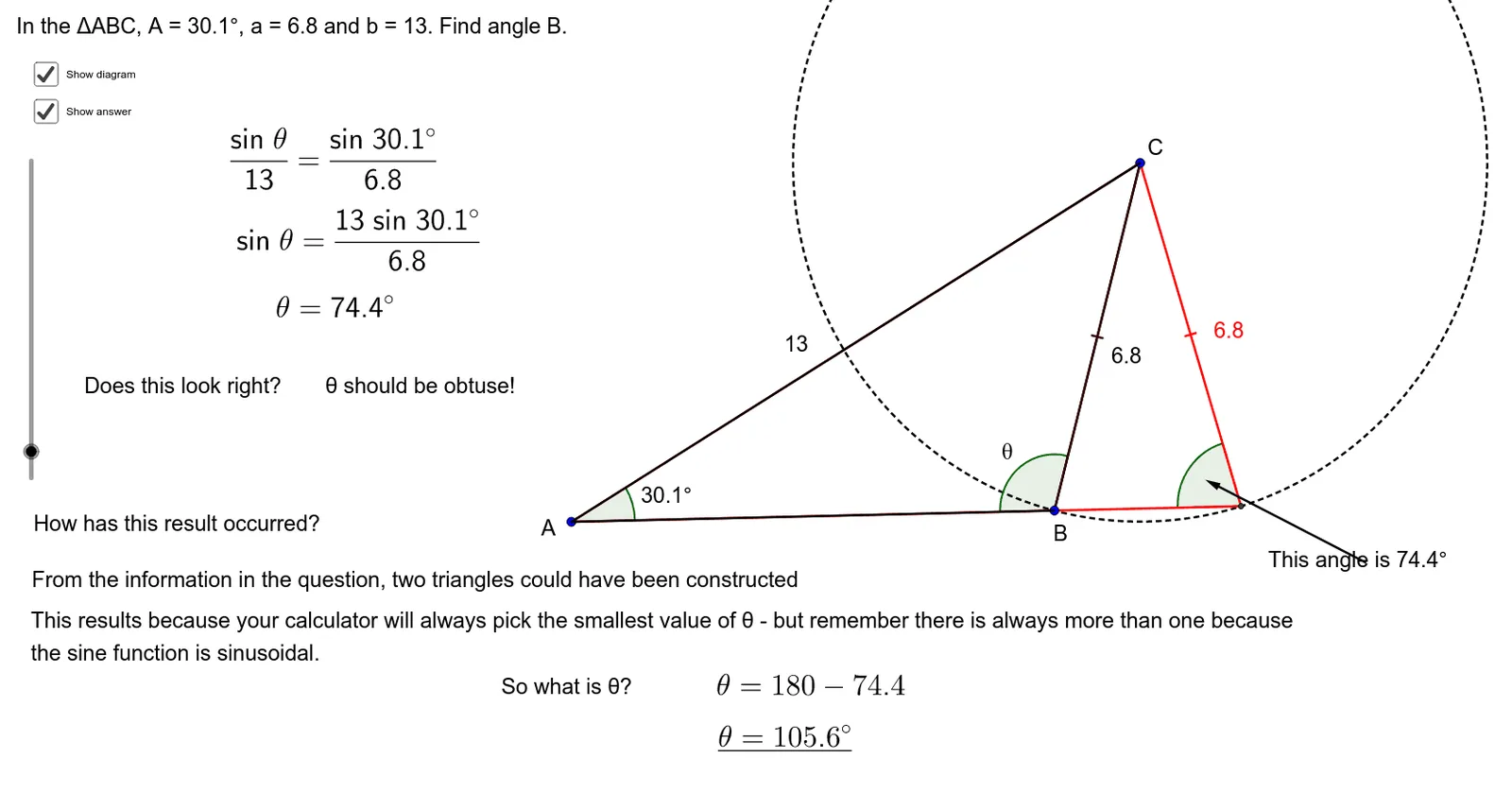
This GeoGebra example dynamically illustrates the ambiguous case of the sine rule, where given two sides and a non-included angle (SSA), the triangle may have two, one, or no solutions. It visually shows how the intersection of a circle and a ray produces two possible vertex positions, leading to two distinct triangles. Core mathematical concepts include the sine rule, triangle solvability conditions, and geometric intersection analysis. The construction uses commands such as Segment, Line, OrthogonalLine, Circle, Intersect, Angle, Distance, and Vector to build the base, draw the perpendicular, create the arc, and find intersection points. Text objects display measured side lengths and angles dynamically. This resource is ideal for high school students learning trigonometry and triangle solving, as well as for teachers demonstrating the SSA ambiguity in class. It helps learners grasp why the number of solutions changes and how to interpret the geometric conditions.
GeoGebra Commands & Parameters
Segment(A, C) → aSegment(C, B) → bSegment(A, B) → cLine(A, B) → dOrthogonalLine(C, d) → eCircle(C, B) → fIntersect(f, d, 2) → DSegment(C, D) → gAngle(B, A, C) → αDistance(A, C) → distanceACDistance(B, C) → distanceBCDistance(B, A) → distanceBAAngle(C, B, A) → βAngle(C, D, B) → γSegment(C, B) → lSegment(B, D) → hCircle(C_1, B_1) → f_1Distance(B_1, C_1) → distanceBC_1Segment(C_1, B_1) → l_1Segment(A, C) → mSegment(B, A) → nVector(E, F) → u
AI Drawing Prompt Reference
Draw a triangle ABC with side AB as c, BC as a, and CA as b. Draw a line AB, then draw a perpendicular line from C to AB, and draw a circle with center C and radius BC, intersecting the perpendicular line at point D. Measure angle BAC as α, the length of BC as b, the length of AB as c, angle BCA as β, and angle BDC as γ. Draw line BC and BD, then draw a circle with center B and radius BC, intersecting AB at point B1, and measure the length of B1C1.
The prompt above was compiled from the original drawing commands and is for reference only.