
Sine Function Equation Construction
Loading the math board and drawing, please wait…
In collections
CCGPS AA Unit 5 Lesson 2
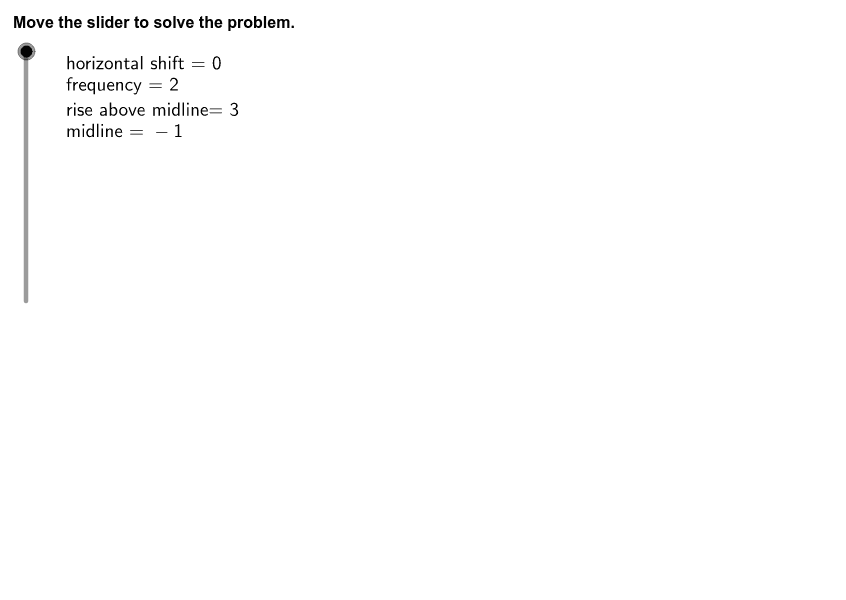
This example demonstrates how to construct a sine function with a frequency of 2 and no horizontal shift. Key mathematical concepts include the properties of sine functions and parametric equations. Using GeoGebra commands such as LaTeX, If, and Simplify, users can dynamically adjust the amplitude and period. Suitable for high school mathematics education and learning.
GeoGebra Commands & Parameters
LaTeX(steps) → counterLaTeX("\text{Determine the value of a.}") → text1LaTeX("\text{The variable a represents the amplitude of the function,}\cr\text{or how far the function rises above its midline.}") → text2LaTeX((((("\text{Since the function rises " * amp) * " units above its midline, its amplitude is ") * amp) * ".}")) → text3LaTeX((("\text{The value of a, the amplitude, is " * amp) * ".}")) → text4LaTeX("\text{Determine the value of b.}") → text5LaTeX("\text{Substitute this value into the formula for the period and solve for b.}") → text8LaTeX((("\text{The value of b is }" * bmult) * "\pi.")) → text10LaTeX("\text{Determine the value of c.}") → text11LaTeX("\text{Determine the value of d.}") → text13LaTeX("\text{The variable d gives the vertical shift. }") → text14If(midline < 0, "down", If[midline > 0, "up", ""]) → directionLaTeX("\text{Substitute a, b, c, and d into the general form of the sine function.}") → text16Simplify((amp * sin(((bmult * π) * (x - xshift)))) + midline) → fLaTeX("\text{Use the buttons below to return to the original problem or}\cr\text{randomly generate a similar practice problem.}") → text19LaTeX((((((((("\text{horizontal shift = }" * xshift) * "\cr\text{frequency = }") * freq) * "\cr\text{rise above midline= }") * amp) * "\cr\text{midline = }") * midline) * "")) → ProblemLaTeX("\text{The period (the length of one cycle of the curve) is equal to }\frac{2\pi}{b},\cr\text{and the frequency is the reciprocal of the period.}") → text6LaTeX((((((("\text{The reciprocal of the given frequency, }" * freq) * "\text{, is }\frac{1}{") * freq) * "}\text{. Thus, }\frac{1}{") * freq) * "}\text{ is the period.}")) → text7LaTeX((((((((((("\text{Since the function’s midline is y = " * midline) * ", this means that the entire}\cr\text{function has been shifted ") * direction) * " ") * abs(midline)) * " unit } (") * midline) * ")\text{, so d = }") * midline) * ".")) → text15TableText({{LaTeX["f(x) = a \sin[b(x – c)] + d"], LaTeX["\text{General form of the sine function}"]}, {LaTeX[(((((((("f(x)=(" * amp) * ")\sin\left[") * bmult) * "\pi\left(x-[") * xshift) * "]\right)\right]+(") * midline) * ")")], LaTeX["\text{Substitute.}"]}, {LaTeX[("f(x)=" * f)], LaTeX["\text{Simplify.}"]}}) → text17LaTeX((("\text{The equation of the function is f(x) = }" * f) * ".")) → text18LaTeX((((("\text{The variable c gives the horizontal shift. }\cr\text{Since the horizontal shift is }" * xshift) * "\text{, c = }") * xshift) * ".")) → text12TableText({{LaTeX["\text{period}=\frac{2\pi}{b}"], LaTeX["\text{Formula for the period}"]}, {LaTeX[(("\frac{1}{" * freq) * "}=\frac{2\pi}{b}")], LaTeX[(("\text{Substitute }\frac{1}{" * freq) * "}\text{ for the period.}")]}, {LaTeX[(("b=" * freq) * "(2\pi)")], LaTeX["\text{Cross multiply to eliminate the fractions.}"]}, {LaTeX[(("b=" * bmult) * "\pi")], LaTeX["\text{Multiply.}"]}}) → text9
AI Drawing Prompt Reference
Construct a sine function graph with frequency 2 and no horizontal shift, where amplitude and vertical shift are adjustable. Show the curve on coordinate axes, along with step-by-step text explanations for determining amplitude, period, horizontal shift, and vertical shift. Display the simplified equation and a table comparing the general form, substitution, and simplification. Include buttons to reset or generate a new practice problem.
The prompt above was compiled from the original drawing commands and is for reference only.