
Sine and Cosine in the Same Right Triangle (Same Reference View)
Loading the math board and drawing, please wait…
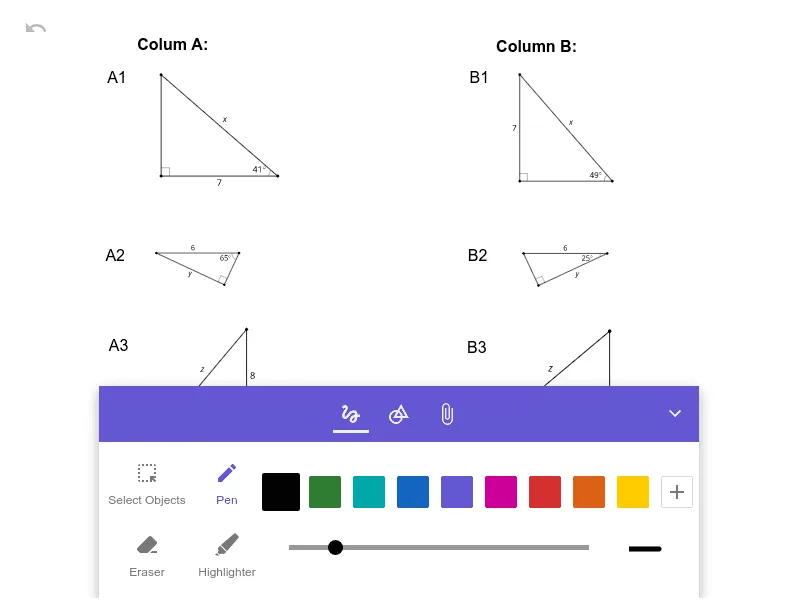
This example demonstrates how, within a single right triangle, sine and cosine are defined and interpreted using the same reference angle and the corresponding side-length ratios. It helps learners see that sin(θ) and cos(θ) come from different side pairs (opposite vs. adjacent) while sharing the same hypotenuse and the same chosen angle. The key concepts are the trigonometric definitions in a right triangle, the relationship between an angle and side ratios, and the idea that trigonometric values are dimensionless measurements of geometry. The provided GeoGebra “construction summary” contains no explicit commands, so the specific GeoGebra objects/commands cannot be extracted here; however, the construction logically requires creating a right triangle, identifying/labeling the relevant sides, and expressing sin(θ) and cos(θ) via computed ratios. Suitable for middle and high school instruction, especially for introducing trigonometry through dynamic geometry and ratio-based reasoning.
AI Drawing Prompt Reference
Please draw a right triangle and label the hypotenuse, opposite side, and adjacent side. Choose a reference angle θ and use the same angle to define sine and cosine. Sine is the ratio of the opposite side to the hypotenuse, and cosine is the ratio of the adjacent side to the hypotenuse. Ensure the diagram is clear, showing how sine and cosine are calculated from different side pairs while sharing the same hypotenuse and angle. Construction order: first draw the right triangle, label the sides, then calculate and label the sine and cosine values.
The prompt above was compiled from the original drawing commands and is for reference only.