
Simultaneous Equations: 4 Lines and 6 Intersections
Loading the math board and drawing, please wait…
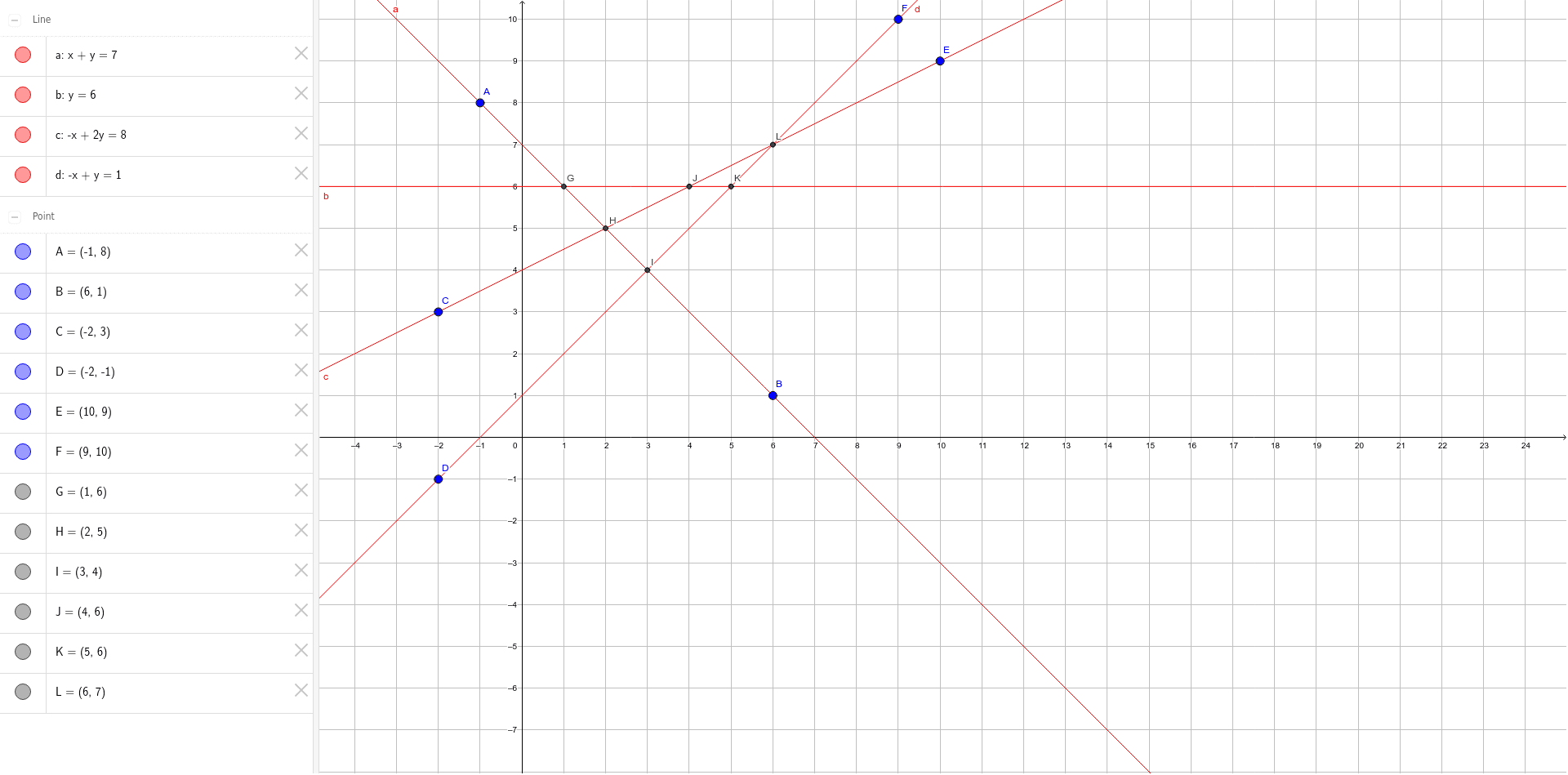
This GeoGebra example demonstrates the graphical solution of simultaneous linear equations by plotting four distinct straight lines in a Cartesian coordinate system and highlighting their six pairwise intersection points. Core mathematical concepts include systems of linear equations, linear functions, slope-intercept form, coordinate geometry, and the geometric interpretation of solutions as intersection points. The construction uses GeoGebra commands Line to draw lines a, b, c, and d, and Intersect to compute and label intersection objects such as A, B, C, D, E, F, G, H, I, J, K, L. It is suitable for middle school algebra, high school analytic geometry, and classroom demonstrations of how systems of equations correspond to line intersections.
GeoGebra Commands & Parameters
Line(A, B) → aLine(C, E) → cLine(D, F) → dIntersect(a, b) → GIntersect(a, c) → HIntersect(a, d) → IIntersect(b, c) → JIntersect(b, d) → KIntersect(c, d) → L
AI Drawing Prompt Reference
Draw four distinct straight lines in a Cartesian coordinate system so that they form six pairwise intersection points. First create the four lines, then mark and highlight the intersection point for each pair of lines. Keep the layout simple and readable, with visible labels for the intersection points if possible. The result should clearly show the four lines and their six intersections, illustrating the graphical solution of simultaneous linear equations.
The prompt above was compiled from the original drawing commands and is for reference only.