
Similar Triangles Ratio Demo
Loading the math board and drawing, please wait…
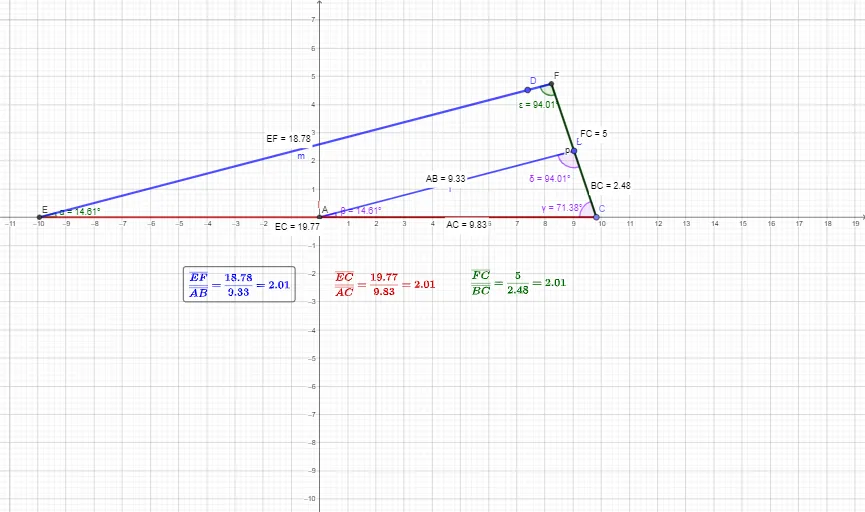
This example demonstrates the ratio relationships in similar triangles. It involves core math concepts like similarity criteria, proportional segments, and angle relationships. Construction highlights include using GeoGebra commands such as Intersect, Segment, Point, Line, Angle, and Distance to build the figure and calculate distances. Suitable for middle school and above students learning properties of similar triangles and geometric constructions.
GeoGebra Commands & Parameters
Intersect(xAxis, yAxis) → ASegment(A, B) → fPoint(xAxis) → CSegment(B, C) → gSegment(A, C) → hLine(D, f) → iLine(C, A) → jLine(C, B) → kIntersect(i, j) → EIntersect(i, k) → FSegment(C, E) → lSegment(E, F) → mSegment(F, C) → nSegment(F, C) → pAngle(C, E, F) → αAngle(C, A, B) → βAngle(F, C, A) → γAngle(A, B, C) → δAngle(D, F, B) → εDistance(A, C) → distanceACDistance(E, C) → distanceECDistance(E, F) → distanceEFDistance(A, B) → distanceABDistance(B, C) → distanceBCDistance(F, C) → distanceFCDistance(E, F) → EFDistance(A, B) → AB
AI Drawing Prompt Reference
Draw a right triangle with a point on the x-axis connected to the right angle vertex. From this point, draw a perpendicular line to the hypotenuse, marking the foot of the perpendicular and another intersection point on the hypotenuse. Connect these points to form two smaller triangles. Label the angles and side lengths of the triangles to demonstrate the ratio relationships in similar triangles.
The prompt above was compiled from the original drawing commands and is for reference only.