
Similar Triangles by Karen Krieger
Loading the math board and drawing, please wait…
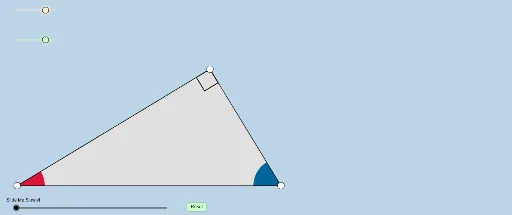
This example demonstrates the properties of similar triangles, involving key concepts such as similarity transformations and corresponding angles. Using GeoGebra commands like Segment, LineBisector, and Dilate, a series of similar triangles can be constructed. Suitable for middle and high school students learning about similar triangles.
GeoGebra Commands & Parameters
Segment(A, B) → aLineBisector(a) → s_3Midpoint(a) → C_1Semicircle(A, B) → dIntersect(d, s_3, 1) → J_2CircleArc(C_1, B, J_2) → t_3Point(t_3) → CSegment(C, B) → fSegment(A, C) → eMin(a, f) → mMin(a, e) → lMin(l, m) → nOrthogonalLine(C_1, a) → bCircle(C_1, A) → cOrthogonalLine(C, a) → gIntersect(g, a) → ESegment(C, E) → hAngle(B, E, C) → αAngle(A, C, B) → βPolygon(A, E, C) → poly1, d_1, a_1, e_1Polygon(E, B, C) → poly2, d_2, e_2, b_1Circle(A, (0.2 * n)) → kCircle(C, (0.2 * n)) → pCircle(B, (0.2 * n)) → qIntersect(p, e_1, 1) → FIntersect(a_1, b_1) → GIntersect(a_1, b_1) → HIntersect(p, h, 1) → IIntersect(p, f, 1) → JIntersect(q, a, 1) → KIntersect(q, f, 1) → LIntersect(k, a, 1) → MIntersect(k, e, 1) → NCircleSector(A, M, N) → rDilate(C, If[-2 < i < -1, -1 - i, 0], E) → D'Segment(C, D') → jCircleSector(B, L, K) → tAngle(C, E, A) → γDilate(A, If[-0.5 < i ≤ 0.5, 0.5 - i, 0], C) → A'Vector(A, A') → uTranslate(r, u) → r'CircleArc(A, M, N) → f_1Dilate(B, If[1.5 < i ≤ 2.5, 2.5 - i, 0], C) → B'Vector(B, B') → vTranslate(t, v) → t'CircleArc(B, L, K) → g_1Polygon(A, B, C) → poly3, d_3, a_2, b_2Rotate(r', If[0.5 < i ≤ 1.5, ((-(i - 0.5)) * π / 2), -1.5707963267948966], C) → r''Translate(t, v) → t'_1Rotate(t'_1, If[2.5 < i ≤ 3.5, (((i - 2.5) * 90))°, 90°], C) → sMirror(E, f) → E'Mirror(E, e) → E'_1Dilate(E, If[4 < i ≤ 5, 5 - i, 0], E'_1) → E'_2Segment(C, E'_2) → h_1Segment(E'_2, A) → i_1Polygon(A, C, E'_2) → t1, e'_2, a_3, c_1Segment(A, C) → j_1Angle(A, E'_1, C) → δDilate(E, If[6 < i ≤ 7, 7 - i, 0], E') → E'_3Segment(C, E'_3) → k_1Segment(E'_3, B) → l_1Segment(C, B) → m_1Polygon(B, E'_3, C) → t2, c_2, b_3, e'_3Angle(C, E', B) → εAngle(E, A, C) → ζCentroid(t1) → DCentroid(t2) → OCentroid(poly3) → PRotate(s, If[7 < i ≤ 8, ((-(i - 7)) * (π / 2 - ζ)), ζ - π / 2], C) → s'Rotate(r'', If[8 < i ≤ 9, ((i - 8) * ζ), ζ], C) → r'''Dilate(D, If[10 < i ≤ 11, 11 - i, 0], P) → D'_1Vector(D, D'_1) → wTranslate(A, w) → A'_1Translate(C, w) → C'Translate(E'_2, w) → QPolygon(A'_1, C', Q) → t1', q_1, a'_1, c'Translate(C, w) → C'_1Translate(E'_2, w) → RSegment(C'_1, R) → n_1Translate(E'_2, w) → STranslate(A, w) → A'_2Segment(S, A'_2) → p_1Translate(A, w) → A'_3Translate(C, w) → C'_2Segment(A'_3, C'_2) → r_1Translate(s', w) → s''Rotate(A'_1, If[10 < i ≤ 11, ((-(i - 10)) * ζ), (-ζ)], D'_1) → TRotate(C', If[10 < i ≤ 11, ((-(i - 10)) * ζ), (-ζ)], D'_1) → C''Rotate(Q, If[10 < i ≤ 11, ((-(i - 10)) * ζ), (-ζ)], D'_1) → Q'Polygon(T, C'', Q') → t1'', q', t_1, c''Rotate(C'_1, If[10 < i ≤ 11, ((-(i - 10)) * ζ), (-ζ)], D'_1) → URotate(R, If[10 < i ≤ 11, ((-(i - 10)) * ζ), (-ζ)], D'_1) → R'Segment(U, R') → s_1Rotate(S, If[10 < i ≤ 11, ((-(i - 10)) * ζ), (-ζ)], D'_1) → S'Rotate(A'_2, If[10 < i ≤ 11, ((-(i - 10)) * ζ), (-ζ)], D'_1) → VSegment(S', V) → f_2Rotate(A'_3, If[10 < i ≤ 11, ((-(i - 10)) * ζ), (-ζ)], D'_1) → WRotate(C'_2, If[10 < i ≤ 11, ((-(i - 10)) * ζ), (-ζ)], D'_1) → ZSegment(W, Z) → g_2Rotate(s'', If[10 < i ≤ 11, ((-(i - 10)) * ζ), (-ζ)], D'_1) → s'''Angle(T, S', U) → ηDilate(O, If[11 < i ≤ 12, 12 - i, 0], P) → O'Vector(O, O') → u_1Translate(B, u_1) → B'_1Translate(E'_3, u_1) → A_1Translate(C, u_1) → C'_3Polygon(B'_1, A_1, C'_3) → t2', c'_3, b'_1, a_4Translate(C, u_1) → C'_4Translate(E'_3, u_1) → D_1Segment(C'_4, D_1) → h_2Translate(E'_3, u_1) → E_1Translate(B, u_1) → B'_2Segment(E_1, B'_2) → i_2Translate(C, u_1) → C'_5Translate(B, u_1) → B'_3Segment(C'_5, B'_3) → j_2Translate(r''', u_1) → k_2Rotate(B'_1, If[11 < i ≤ 12, ((i - 11) * (π / 2 - ζ)), π / 2 - ζ], O') → B_1Rotate(A_1, If[11 < i ≤ 12, ((i - 11) * (π / 2 - ζ)), π / 2 - ζ], O') → F_1Rotate(C'_3, If[11 < i ≤ 12, ((i - 11) * (π / 2 - ζ)), π / 2 - ζ], O') → G_1Polygon(B_1, F_1, G_1) → t2'', g_3, b_4, f_3Rotate(C'_4, If[11 < i ≤ 12, ((i - 11) * (π / 2 - ζ)), π / 2 - ζ], O') → H_1Rotate(D_1, If[11 < i ≤ 12, ((i - 11) * (π / 2 - ζ)), π / 2 - ζ], O') → I_1Segment(H_1, I_1) → l_2Rotate(E_1, If[11 < i ≤ 12, ((i - 11) * (π / 2 - ζ)), π / 2 - ζ], O') → J_1Rotate(B'_2, If[11 < i ≤ 12, ((i - 11) * (π / 2 - ζ)), π / 2 - ζ], O') → K_1Segment(J_1, K_1) → m_2Rotate(C'_5, If[11 < i ≤ 12, ((i - 11) * (π / 2 - ζ)), π / 2 - ζ], O') → L_1Rotate(B'_3, If[11 < i ≤ 12, ((i - 11) * (π / 2 - ζ)), π / 2 - ζ], O') → M_1Segment(L_1, M_1) → n_2Rotate(k_2, If[11 < i ≤ 12, ((i - 11) * (π / 2 - ζ)), π / 2 - ζ], O') → p_2Angle(G_1, J_1, B_1) → θDilate(T, If[13 < i ≤ 14, 14 - i, 0], A) → T'Vector(T, T') → v_1Translate(T, v_1) → T'_1Translate(C'', v_1) → C'''Translate(Q', v_1) → Q''Polygon(T'_1, C''', Q'') → t1''', q'', t'_2, c'''Translate(S', v_1) → S''Translate(V, v_1) → V'Segment(S'', V') → q_2Translate(W, v_1) → W'Translate(Z, v_1) → Z'Segment(W', Z') → r_2Translate(U, v_1) → U'Translate(R', v_1) → R''Segment(U', R'') → s_2Translate(s''', v_1) → t_2Angle(Z', R'', V') → ιDilate(G_1, If[13 < i ≤ 14, 14 - i, 0], A) → N_1Vector(G_1, N_1) → w_1Translate(B_1, w_1) → O_1Translate(F_1, w_1) → P_1Translate(G_1, w_1) → Q_1Polygon(O_1, P_1, Q_1) → t2''', q_3, o_1, p_3Translate(p_2, w_1) → c_3Translate(H_1, w_1) → R_1Translate(I_1, w_1) → S_1Segment(R_1, S_1) → h_3Translate(J_1, w_1) → T_1Translate(K_1, w_1) → U_1Segment(T_1, U_1) → i_3Translate(L_1, w_1) → V_1Translate(M_1, w_1) → W_1Segment(V_1, W_1) → j_3Angle(R_1, T_1, O_1) → κDilate(Z', If[15 < i ≤ 16, 16 - i, 0], B) → Z''Vector(Z', Z'') → u_2Translate(T'_1, u_2) → Z_1Translate(C''', u_2) → A_2Translate(Q'', u_2) → Q'''Polygon(Z_1, A_2, Q''') → t3, q''', z_1, a_5Translate(t_2, u_2) → e_3Translate(U', u_2) → U''Translate(R'', u_2) → R'''Segment(U'', R''') → k_3Translate(S'', u_2) → S'''Translate(V', u_2) → V''Segment(S''', V'') → l_3Angle(V'', S''', U'') → λDilate(O_1, If[15 < i ≤ 16, 16 - i, 0], B) → B_2Vector(O_1, B_2) → v_2Translate(O_1, v_2) → C_2Translate(P_1, v_2) → D_2Translate(Q_1, v_2) → E_2Polygon(C_2, D_2, E_2) → t4, e_4, c_4, d_4Translate(c_3, v_2) → r_3Translate(R_1, v_2) → F_2Translate(S_1, v_2) → G_2Segment(F_2, G_2) → m_3Translate(T_1, v_2) → H_2Translate(U_1, v_2) → I_2Segment(H_2, I_2) → n_3Angle(F_2, H_2, B_2) → μ
AI Drawing Prompt Reference
Draw two similar triangles, triangle ABC and triangle EBC. Start by drawing line segment AB, then construct the perpendicular bisector of AB to find midpoint C. Draw a circular arc with C as the center and connect points C and B, and then connect points C and E. Construct two similar triangles by using similarity transformations, one by enlarging and one by reducing triangle ABC to form triangle EBC and another similar triangle to triangle ABC.
The prompt above was compiled from the original drawing commands and is for reference only.