
Similar Rectangles by garnettn
Loading the math board and drawing, please wait…
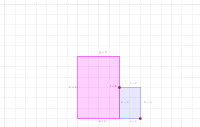
This example demonstrates how to adjust the size of rectangles while maintaining similarity. Key mathematical concepts include the properties of similar figures and proportional relationships. Using GeoGebra commands such as Point, OrthogonalLine, Intersect, and Polygon, a series of similar rectangles can be constructed. Suitable for students at the junior high school level and above to learn about the concept of similar figures.
GeoGebra Commands & Parameters
Point(xAxis) → BOrthogonalLine(B, xAxis) → a_3Point(yAxis) → COrthogonalLine(C, yAxis) → b_2OrthogonalLine(E, xAxis) → c_2OrthogonalLine(D, yAxis) → d_2Intersect(c_2, d_2) → FPolygon(E, A, D, F) → poly1, e, f, g, hIntersect(a_3, b_2) → GPolygon(C, A, B, G) → poly2, d, a, b, c
AI Drawing Prompt Reference
Draw two similar rectangles. Start by taking a point B on the x-axis and drawing a line a_3 perpendicular to the x-axis through B. Then take a point C on the y-axis and draw a line b_2 perpendicular to the y-axis through C. Next, draw a line c_2 perpendicular to the x-axis through point E, and a line d_2 perpendicular to the y-axis through point D, which intersect at point F. Connect points E, A, D, and F to form rectangle poly1. Finally, draw a line a_3 and b_2 intersecting at point G, and connect points C, A, B, and G to form rectangle poly2.
The prompt above was compiled from the original drawing commands and is for reference only.