
Sierpinski Triangle by Sangeeta Gulati
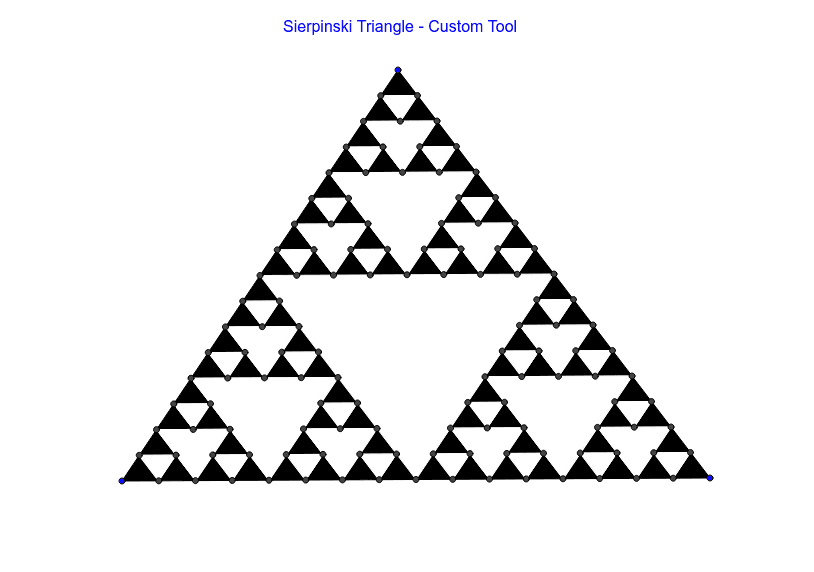
Loading the math board and drawing, please wait…
This example demonstrates the construction of the Sierpinski Triangle, a fractal geometry figure. The process involves creating an initial triangle and recursively generating smaller triangles using the Polygon, Midpoint, and Sierpinski commands. Suitable for high school mathematics education and learning fractal geometry concepts.
GeoGebra Commands & Parameters
Polygon(A, B, C) → poly1, c, a, bMidpoint(a) → DMidpoint(b) → EMidpoint(c) → FPolygon(F, E, D) → poly2, d, f, eSierpinski(B, D, F) → G, H, I, g, h, i, poly3Sierpinski(D, C, E) → J, K, L, j, k, l, poly4Sierpinski(F, E, A) → M, N, O, m, n, p, poly5Sierpinski(B, I, H) → P, Q, R, q, r, s, poly6Sierpinski(I, D, G) → S, T, U, t, a_1, b_1, poly7Sierpinski(H, G, F) → V, W, Z, c_1, d_1, e_1, poly8Sierpinski(F, O, N) → A_1, B_1, C_1, f_1, g_1, h_1, poly9Sierpinski(N, M, A) → D_1, E_1, F_1, i_1, j_1, k_1, poly10Sierpinski(O, E, M) → G_1, H_1, I_1, l_1, m_1, n_1, poly11Sierpinski(K, J, E) → J_1, K_1, L_1, p_1, q_1, r_1, poly12Sierpinski(D, L, K) → M_1, N_1, O_1, s_1, t_1, a_2, poly13Sierpinski(L, C, J) → P_1, Q_1, R_1, b_2, c_2, d_2, poly14Sierpinski(E_1, D_1, A) → S_1, T_1, U_1, e_2, f_2, g_2, poly15Sierpinski(N, F_1, E_1) → V_1, W_1, Z_1, h_2, i_2, j_2, poly16Sierpinski(F_1, M, D_1) → A_2, B_2, C_2, k_2, l_2, m_2, poly17Sierpinski(B_1, A_1, N) → D_2, E_2, F_2, n_2, p_2, q_2, poly18Sierpinski(H_1, G_1, M) → G_2, H_2, I_2, r_2, s_2, t_2, poly19Sierpinski(F, C_1, B_1) → J_2, K_2, L_2, a_3, b_3, c_3, poly20Sierpinski(C_1, O, A_1) → M_2, N_2, O_2, d_3, e_3, f_3, poly21Sierpinski(O, I_1, H_1) → P_2, Q_2, R_2, g_3, h_3, i_3, poly22Sierpinski(I_1, E, G_1) → S_2, T_2, U_2, j_3, k_3, l_3, poly23Sierpinski(W, V, F) → V_2, W_2, Z_2, m_3, n_3, p_3, poly24Sierpinski(H, Z, W) → A_3, B_3, C_3, q_3, r_3, s_3, poly25Sierpinski(Z, G, V) → D_3, E_3, F_3, t_3, a_4, b_4, poly26Sierpinski(Q, P, H) → G_3, H_3, I_3, c_4, d_4, e_4, poly27Sierpinski(G, T, S) → J_3, K_3, L_3, f_4, g_4, h_4, poly28Sierpinski(Q, B, R) → M_3, N_3, O_3, i_4, j_4, k_4, poly29Sierpinski(P, R, I) → P_3, Q_3, R_3, l_4, m_4, n_4, poly30Sierpinski(T, I, U) → S_3, T_3, U_3, p_4, q_4, r_4, poly31Sierpinski(S, U, D) → V_3, W_3, Z_3, s_4, t_4, a_5, poly32Sierpinski(E, K_1, J_1) → A_4, B_4, C_4, b_5, c_5, d_5, poly33Sierpinski(K_1, K, L_1) → D_4, E_4, F_4, e_5, f_5, g_5, poly34Sierpinski(J_1, L_1, J) → G_4, H_4, I_4, h_5, i_5, j_5, poly35Sierpinski(J, Q_1, P_1) → J_4, K_4, L_4, k_5, l_5, m_5, poly36Sierpinski(P_1, R_1, C) → M_4, N_4, O_4, n_5, p_5, q_5, poly37Sierpinski(Q_1, L, R_1) → P_4, Q_4, R_4, r_5, s_5, t_5, poly38Sierpinski(K, N_1, M_1) → S_4, T_4, U_4, a_6, b_6, c_6, poly39Sierpinski(N_1, D, O_1) → V_4, W_4, Z_4, d_6, e_6, f_6, poly40Sierpinski(M_1, O_1, L) → A_5, B_5, C_5, g_6, h_6, i_6, poly41