
Sierpinski Probability Tree: Fractal via Random Iteration
Loading the math board and drawing, please wait…
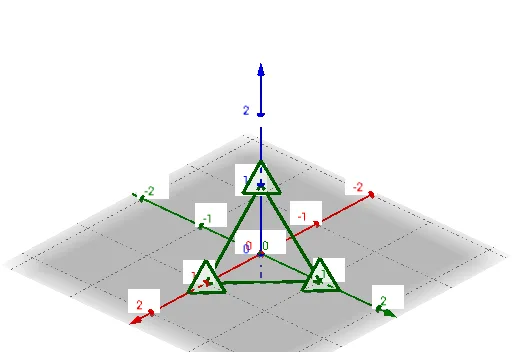
This example demonstrates how to generate a Sierpinski triangle-like fractal tree structure through probabilistic iteration, illustrating a geometric construction based on random processes. The core mathematical concepts include fractal geometry, probability distributions, iteration and limits, and self-similarity in set theory. Construction highlights: using GeoGebra's Polygon command to create an initial polygon (e.g., a triangle), and the Sequence command to generate a series of random points that interpolate between existing vertices according to specific probability rules, gradually forming the Sierpinski pattern. This is suitable for high school and above, helping students understand fractals, probabilistic simulation, and recursive thinking, and can serve as an intuitive teaching tool for mathematical experiments or introductory programming.
GeoGebra Commands & Parameters
Polygon(A1) → L1Sequence(Polygon[(A1 * 1 / 3) + Element[A1, i]], i, 1, 3) → L2