
Sector to Cone Lateral Area by Alfred Estberg
Loading the math board and drawing, please wait…
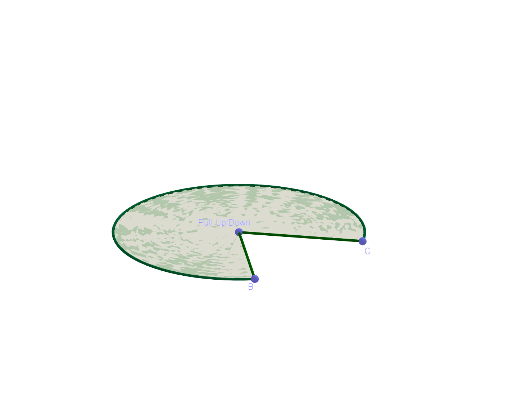
This example demonstrates how a sector can be transformed into the lateral surface of a cone. Key mathematical concepts include circles, arc length, sector area, and lateral surface area of a cone. Using GeoGebra commands such as Circle, Rotate, Sector, and Arc, the dynamic relationship between the sector and the cone is illustrated. Suitable for high school geometry and solid geometry courses.
GeoGebra Commands & Parameters
Circle((0, 0, 0), CircleRad, zAxis) → cPoint(c) → BRotate(B, 0.1°, zAxis) → B'_1Rotate(B, 359°, zAxis) → B'CircumcircleArc(B, B'_1, B') → dPoint(d) → CAngularBisector(C, A, B) → jSector(c, C, B) → gArc(c, C, B) → eCircle(A, ConeRad, zAxis) → hIntersect(j, h) → F, GCircle(C, G, B) → rCircle(C, F, B) → pSegment(A, D) → iPoint(i) → ECircle(A, ChangingRad, zAxis) → qIntersect(r, q) → J, K, ,Intersect(q, p) → H, I, ,If(g < ((0.5 * π) * CircleRad^(2)), K, H) → LSegment(A, L) → sIf(g < ((1 / 2 * π) * CircleRad^(2)), J, I) → MAngle(M, A, L, zAxis) → αLine((0, 0, 0), (0, 0, 1)) → fSegment(L, E) → lSegment(M, E) → mSegment(M, A) → tLine(L, E) → f_1Surface((u * cos(v)), (u * sin(v)), w(u), u, 0, ChangingRad, v, If[Distance[C, M] < Distance[C, L], 360° - α, 0°], If[Distance[C, M] < Distance[C, L], 360°, 360° - α]) → bCone(A, D, ConeRad) → a, k, nRotate(b, (-Angle[L, A, (1, 0, 0), zAxis]), zAxis) → n'Circle(A, ChangingRad, zAxis) → c_1Intersect(j, c_1) → N, OAngle(C, A, B, zAxis) → βIf(β < 180° ∧ α > 180°, CircleArc[A, L, M], If[β < 180° ∧ α < 180°, CircumcircleArc[L, N, M], CircumcircleArc[L, O, M]]) → d_1Segment(A, E) → g_1
AI Drawing Prompt Reference
Draw a 3D geometric scene: a circle as the base of a cone, centered at the origin with adjustable radius. Pick a point on the circle and rotate it around the vertical axis to form an arc, creating a sector with the center. The sector changes dynamically, and its area relates to the lateral surface area of the cone. Also draw a cone with apex above the origin and adjustable base radius, whose lateral surface is formed by rolling up the sector. Show the dynamic connection: the arc length of the sector equals the base circumference, and the sector area equals the lateral area. Include the cone's height, slant edges, and auxiliary lines, with angles labeled.
The prompt above was compiled from the original drawing commands and is for reference only.