
Scalar Multiplication: Vector Scaling and Geometric Visualization
Loading the math board and drawing, please wait…
In collections
Vector Basics
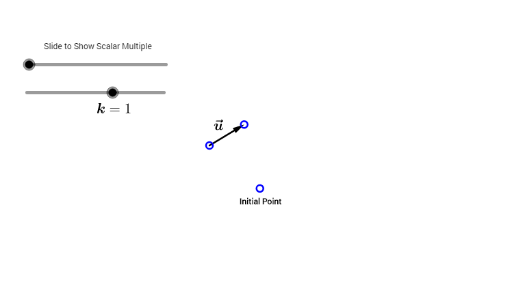
① This example demonstrates the geometric meaning of scalar multiplication: a slider or parameter k controls the scaling of vector u, showing the resulting vector and its position changes in the plane. ② Core mathematical concepts include vector scalar multiplication, collinearity, proportional relationships, and properties of translation and midpoint in plane geometry. ③ Construction highlights: using GeoGebra commands Vector to create vector u, Translate to move points and generate multiple copies (C', C'', C''' etc.), Segment to connect relevant points, Point and Midpoint to determine key locations, and multiple auxiliary objects (like a, b, c, d and their primed versions) to build a complete geometric relationship diagram, with a slider k dynamically showing the effect of scalar multiplication on vector length and direction. ④ Suitable for high school or early college students learning vector algebra and geometric intuition, and also useful for teachers to demonstrate interactive scalar multiplication in class.
GeoGebra Commands & Parameters
Vector(A, B) → uTranslate(C, u) → C'Translate(C', u) → C''Translate(C'', u) → C'''Translate(C''', u) → C''''Segment(C, C') → aSegment(C', C'') → bSegment(C'', C''') → cSegment(C''', C'''') → dSegment(A, C) → a'Segment(A, C') → b'Segment(A, C'') → c'Segment(A, C''') → d'Point(a', n) → A_1Point(b', n - 1) → B_1Translate(A_1, u) → DVector(A_1, D) → a_1Translate(B_1, u) → EVector(B_1, E) → b_1Translate(C, Fin) → EndCSegment(C, EndC) → CEndCPoint(CEndC, ((n - abs(k)) * 2 / abs(k))) → AlmEndVector(C, AlmEnd) → EndTranslate(C, Vector[(-u)]) → C'_1Translate(C'_1, Vector[(-u)]) → C''_1Translate(C''_1, Vector[(-u)]) → C'''_1Translate(C'''_1, Vector[(-u)]) → C''''_1Segment(C, C'_1) → eSegment(C'_1, C''_1) → fSegment(C''_1, C'''_1) → gSegment(C'''_1, C''''_1) → hSegment(A, C'_1) → e'Segment(A, C''_1) → f'Segment(A, C'''_1) → g'Segment(A, C''''_1) → h'Point(c', n - 2) → C_1Point(d', n - 3) → D_1Translate(C_1, u) → FVector(C_1, F) → c_1Translate(D_1, u) → GVector(D_1, G) → d_1Point(e', n - 1) → E_1Translate(E_1, Vector[(-u)]) → HVector(E_1, H) → e_1Translate(A_1, Vector[(-u)]) → IVector(A_1, I) → a_1'Point(f', n - 2) → F_1Point(g', n - 3) → G_1Translate(F_1, Vector[(-u)]) → JVector(F_1, J) → f_1Translate(G_1, Vector[(-u)]) → KVector(G_1, K) → g_1Translate(A, Vector[(-u)]) → A'Vector(A, A') → vMidpoint(C, AlmEnd) → Mid