
Rotational Vectors: Dynamic Demonstration of Vector Rotation and Angle
Loading the math board and drawing, please wait…
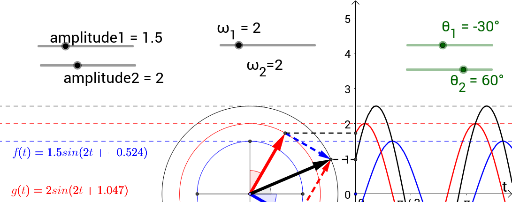
① This GeoGebra example dynamically demonstrates how vectors rotate around a point in the plane, simultaneously showing the rotation angle, vector length, and endpoint locus, making the geometric meaning of vector rotation intuitive. ② Core mathematical concepts include vector rotation, angle measurement, vector addition and translation, and coordinate changes before and after rotation, involving trigonometric functions in coordinate transformations. ③ Construction highlights: Circle commands create reference circles, Rotate rotates vectors, Angle objects measure rotation angles, Vector and Segment draw vectors and edges, Translate constructs auxiliary figures, Textfield inputs rotation speed, sliders (like speed) control dynamics, and multiple points (A, B, C) and auxiliary circles (ω_1, ω_2) build the complete scene. ④ Suitable for high school or early college students learning vector geometry and rotation transformations, also useful for teachers in classroom demonstrations or students' self-exploration of rotation rules, helping understand the connection between vector operations and coordinate systems.
GeoGebra Commands & Parameters
Circle(C, amplitude1) → cRotate(B, θ_1 + θ, C) → B'Angle(B, C, B') → αVector(C, B') → r_3Segment(B', D) → eSegment(G, H) → fSegment(C, B') → r_1Rotate(A, θ_2 + θ, C) → B'_1Vector(C, B'_1) → uSegment(C, B'_1) → r_2Circle(C, amplitude2) → kAngle(A, C, B'_1) → βSegment(B'_1, J) → iTranslate(B', u) → B''Vector(B', B'') → vVector(C, B'') → wCircle(C, B'') → qTextfield(θ_2) → inputBox2Textfield(θ_1) → inputBox1Segment(I, B'') → jVector(B'_1, B'') → lVector(B', B'') → mSegment(E, B) → nAngle(B'_1, C, G) → γAngle(B, C, B'') → δ