
Root Rectangle 6
Loading the math board and drawing, please wait…
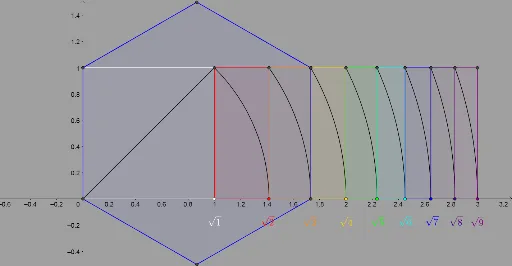
This example demonstrates the construction of root rectangle 6. A root rectangle is a special rectangle where the length of the diagonal is the square root of the side length. The core mathematical concepts involved include square root operations and the Pythagorean theorem. Using GeoGebra commands such as Point, Segment, Polygon, Circle, etc., the construction of root rectangle 6 is illustrated. Suitable for students at the junior high school level and above for geometric construction.
GeoGebra Commands & Parameters
Point(xAxis) → APoint(xAxis) → BPoint(xAxis) → DPoint(yAxis) → ESegment(O, P) → nPoint(xAxis) → CPoint(xAxis) → GPolygon(C, G, 4) → poly1, f, g, h, i, H, ISegment(C, H) → jLine(C, G) → kCircle(C, H) → cIntersect(c, k, 2) → JOrthogonalLine(J, k) → lLine(H, k) → mIntersect(l, m) → A_1Polygon(G, H, A_1, J) → q1, g_1, h_1, a_1, j_1Circle(C, A_1) → dIntersect(d, k, 2) → B_1Line(B_1, l) → pIntersect(m, p) → C_1Polygon(J, B_1, C_1, A_1) → q2, j_2, b_1, c_1, qCircle(C, C_1) → eIntersect(e, k, 2) → D_1Line(D_1, p) → rIntersect(m, r) → E_1Polygon(B_1, D_1, E_1, C_1) → q3, s, d_1, e_1, tCircle(C, E_1) → f_1Intersect(f_1, k, 2) → F_1Line(F_1, r) → aIntersect(m, a) → G_1Polygon(D_1, F_1, G_1, E_1) → q4, b, i_1, k_1, l_1Circle(C, G_1) → p_1Intersect(p_1, k, 2) → H_1Line(H_1, a) → m_1Intersect(m, m_1) → I_1Polygon(F_1, H_1, I_1, G_1) → q5, n_1, q_1, r_1, s_1Circle(C, I_1) → t_1Intersect(t_1, k, 2) → J_1Line(J_1, m_1) → f_2Intersect(m, f_2) → K_1Polygon(H_1, J_1, K_1, I_1) → q6, g_2, h_2, i_2, k_2Circle(C, K_1) → c_2Intersect(c_2, k, 2) → L_1Line(L_1, f_2) → l_2Intersect(m, l_2) → M_1Polygon(J_1, L_1, M_1, K_1) → q7, m_2, n_2, p_2, q_2Circle(C, M_1) → d_2Intersect(d_2, k, 2) → N_1Line(N_1, l_2) → r_2Intersect(m, r_2) → O_1Polygon(L_1, N_1, O_1, M_1) → q8, s_2, t_2, o_1, a_2CircleArc(C, J, H) → e_2CircleArc(C, B_1, A_1) → c_3CircleArc(C, D_1, C_1) → d_3CircleArc(C, F_1, E_1) → e_3CircleArc(C, J_1, I_1) → f_3CircleArc(C, H_1, G_1) → g_3CircleArc(C, L_1, K_1) → h_3CircleArc(C, N_1, M_1) → k_3Polygon(I, C, 6) → poly2, b_2, S_1, i_3, j_3, l_3, m_3, n_3, P_1, Q_1, R_1