
Roman Mosaic Geometric Pattern: Rotation and Sequence Transformation
Loading the math board and drawing, please wait…
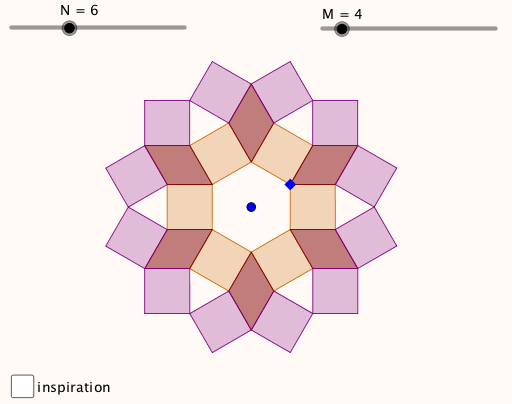
This example demonstrates the generation of Roman mosaic-style geometric tessellation patterns. Core math concepts include symmetry, polygon area, rotation transformations, and sequence construction. Construction utilizes GeoGebra's Sequence command to generate point lists, Rotate command for angular transformations, and Polygon command to close and build polygonal regions. Suitable for middle school geometry teaching or mathematical art appreciation, helping students intuitively understand planar transformations and symmetry laws.
GeoGebra Commands & Parameters
Sequence(Rotate[Polygon[Rotate[B, (360 * ° / N), A], B, M], ((i * 360) * ° / N), A], i, 1, N) → list1Distance(B, Rotate[B, (360 * ° / N), A]) → sRotate(B + (s * (B - A) / Distance[A, B]), ang / 2, B) → CRotate(C, (-ang), B) → C'Rotate(B, 180° - ang, C) → B'Sequence(Polygon[Rotate[B, ((i * 360) * ° / N), A], Rotate[C, ((i * 360) * ° / N), A], Rotate[B', ((i * 360) * ° / N), A], Rotate[C', ((i * 360) * ° / N), A]], i, 1, N) → list2Polygon(C, B', M) → poly1, f, q_1, t_1, c_1, D, E, K, P, S, V, A_1, g, D_1, G_1, J_1, h, i, a, d, g_1, j_1, m_1Sequence(Rotate[poly1, ((i * 360) * ° / N), A], i, 1, N) → list3Polygon(B', C', M) → poly2, j, r_1, a_1, d_1, F, G, L, Q, T, W, B_1, k, E_1, H_1, K_1, l, m, b, e, h_1, k_1, n_1Sequence(Rotate[poly2, ((i * 360) * ° / N), A], i, 1, N) → list4