
Rigid Transformations Practice: Translations, Rotations, and Reflections (1)
Loading the math board and drawing, please wait…
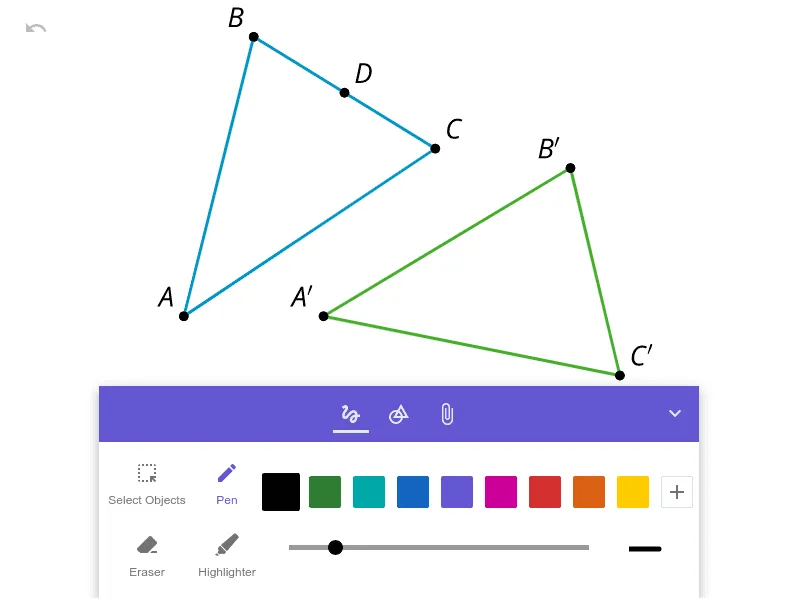
①This example demonstrates the fundamental properties of rigid transformations (translations, rotations, and reflections) in plane geometry, visually showing how shapes move while preserving size and shape. ②Core mathematical concepts include the definition of rigid transformations, distance preservation, angle preservation, composition of transformations, and inverse transformations, involving basic elements like function graphs, straight lines, and special points. ③Construction highlights: from the summary, the example uses an image object (pic1) as a background or reference, likely combined with GeoGebra's transformation tools (e.g., translate, rotate, reflect) to manipulate figures, though specific commands are not fully listed; it may involve points, lines, polygons, and their transformations. ④Suitable for middle school to high school students, for classroom practice or self-exploration of geometric transformations, helping to understand the geometric meaning and coordinate representation of transformations.
AI Drawing Prompt Reference
Create a coordinate-plane scene to practice rigid transformations in plane geometry: use a reference image as a background and, within one coordinate system, include a function graph together with several straight lines and key points. Construct and display the image of the same shape under a translation, a rotation, and a reflection across a line, keeping the emphasis on preserving distances and angles. Build the diagram in order from the original figure to the translated copy, then the rotated copy, then the reflected copy; label corresponding points to show the maintained metric and angular relationships, and finally indicate how composing transformations relates to the same resulting position, with the inverse transformation bringing the figure back.
The prompt above was compiled from the original drawing commands and is for reference only.