
Riemann Sphere Projection (f(z)=1/z or f(z)=z^2)
Loading the math board and drawing, please wait…
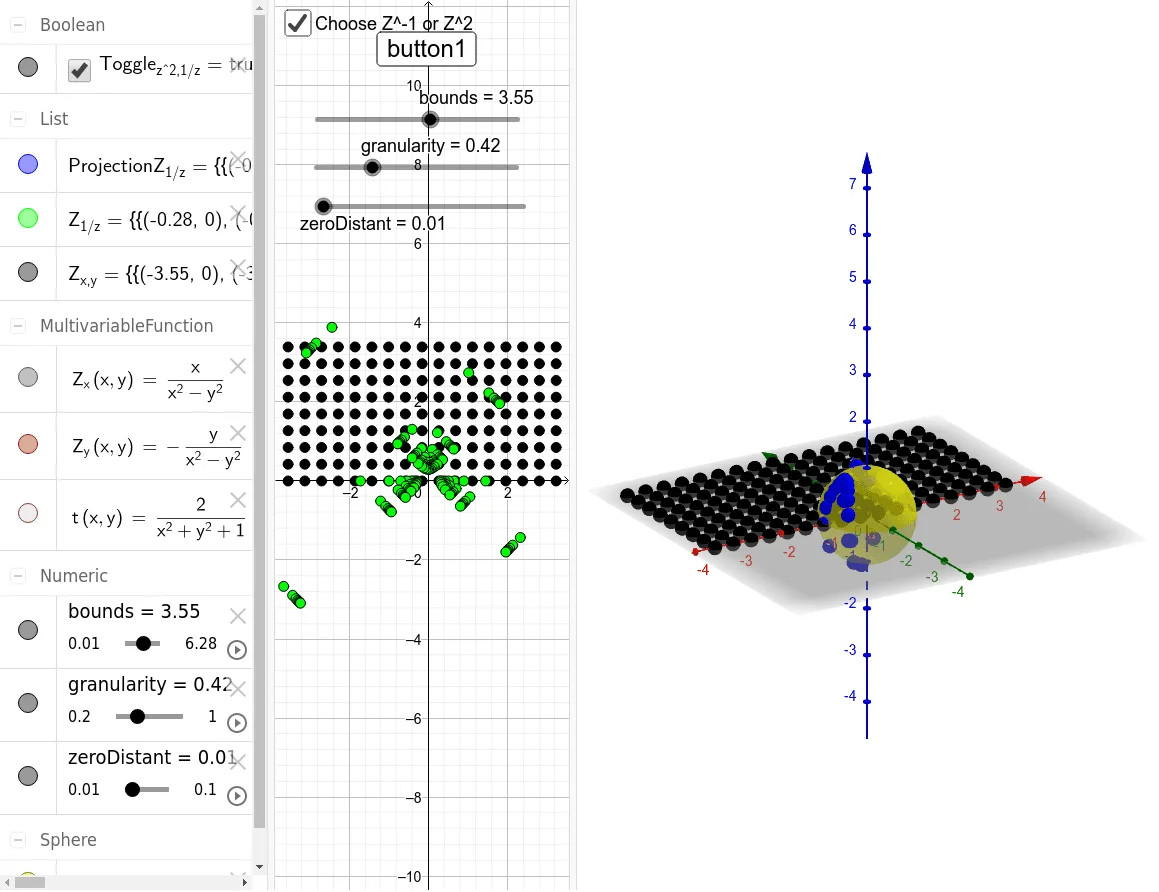
This example demonstrates the Riemann Sphere Projection, showing the mapping between the sphere and the complex plane by transforming points in the complex plane. Core mathematical concepts include complex numbers, function transformations, and projection geometry. Construction highlights use of the GeoGebra Sequence command to generate sequences, button1 to toggle projection functions, zeroDistant and bounds to define boundaries, granularity to set precision, Toggle_{z^2,1/z} to switch functions, Z_x, Z_y for coordinates, t as a parameter, Sphere to draw the sphere, Z_{x,y}, Z_{1/z} for points in different coordinate systems, and ProjectionZ_{1/z} for projection. Suitable for high school and above mathematics learning to understand the geometric meaning of complex functions.
GeoGebra Commands & Parameters
Sequence(Sequence[(θ_{x}, θ_{y}), θ_{x}, (-bounds), bounds, granularity], θ_{y}, 0, bounds, granularity) → Z_{x,y}Sequence(Sequence[(Z_x((θ_{x}, θ_{y})), Z_y((θ_{x}, θ_{y}))), θ_{x}, (-bounds), bounds, granularity], θ_{y}, 0, bounds, granularity) → Z_{1/z}Sequence(Sequence[((x(Element[Z_{1/z}, n_{x}, n_{y}]) * t(x(Element[Z_{1/z}, n_{x}, n_{y}]), y(Element[Z_{1/z}, n_{x}, n_{y}]))), (y(Element[Z_{1/z}, n_{x}, n_{y}]) * t(x(Element[Z_{1/z}, n_{x}, n_{y}]), y(Element[Z_{1/z}, n_{x}, n_{y}]))), t(x(Element[Z_{1/z}, n_{x}, n_{y}]), y(Element[Z_{1/z}, n_{x}, n_{y}])) - 1), n_{x}, 1, Length[Element[Z_{1/z}, 1]], n_{y}], n_{y}, 1, Length[Z_{1/z}], 1) → ProjectionZ_{1/z}