
Rhombus Properties and Construction
Loading the math board and drawing, please wait…
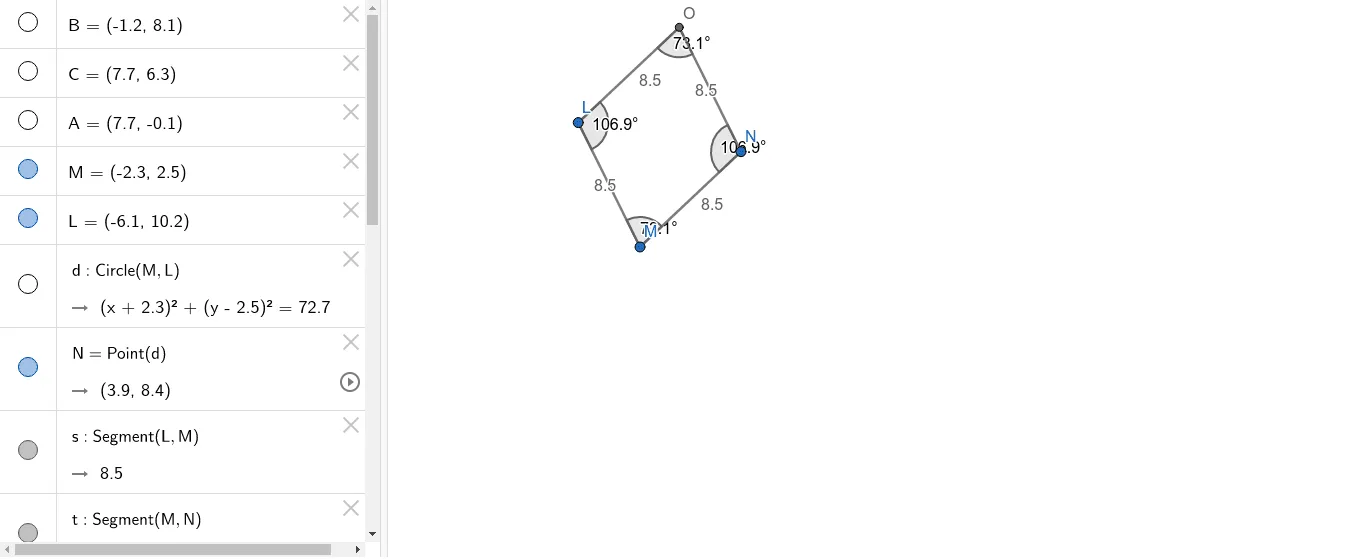
This example demonstrates the fundamental geometric properties of a rhombus and its construction method. By creating a circle with a given center O and radius, then determining vertices A, B, C, and D, a complete rhombus is constructed. Core mathematical concepts include: the diagonals of a rhombus are perpendicular bisectors, adjacent sides are equal, opposite sides are parallel, and all interior angles sum to 360 degrees. Construction uses: Circle command for auxiliary circle, Point command for vertices, Segment command for edges, Line command for diagonals, Intersect command for intersection points, and Angle command for angle marking. Suitable for middle school geometry teaching, explaining relationships between parallelograms and rhombuses, or as geometry construction practice material.
GeoGebra Commands & Parameters
Circle(M, L) → dPoint(d) → NSegment(L, M) → sSegment(M, N) → tLine(L, t) → aLine(N, s) → bIntersect(a, b) → OSegment(L, O) → eSegment(O, N) → f_1Angle(L, M, N) → αAngle(M, N, O) → βAngle(N, O, L) → γAngle(M, L, O) → δ