
Rhombus Investigation by Khiry
Loading the math board and drawing, please wait…
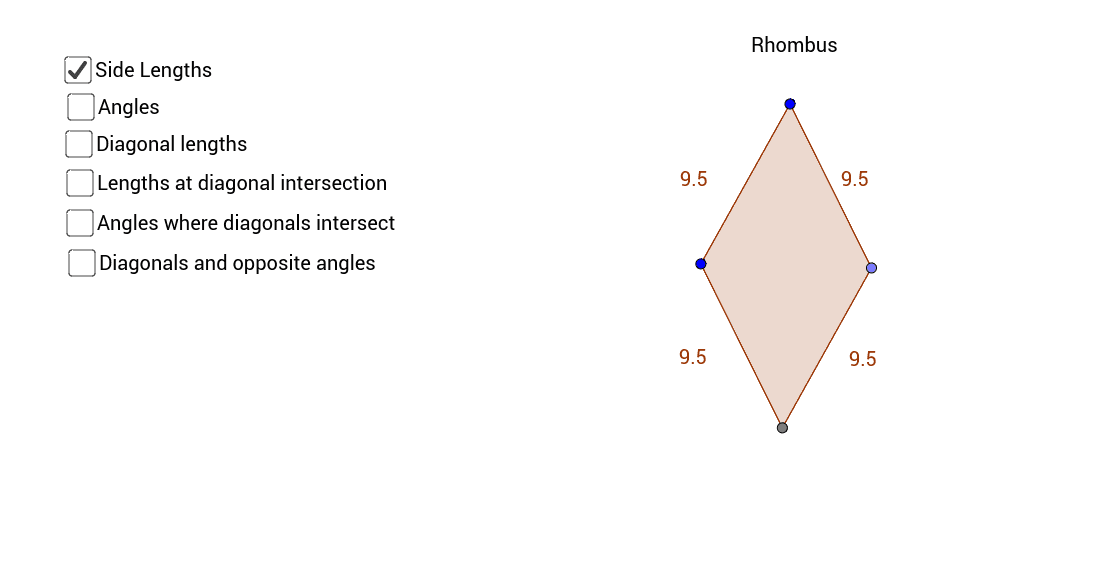
This GeoGebra example guides learners through a dynamic investigation of rhombus properties, including equal side lengths, perpendicular diagonals, and angle bisection. Core mathematical concepts involve polygon geometry, angle measurement, and length calculations. The construction utilizes GeoGebra commands such as Circle, Point, Midpoint, Mirror, Polygon, Angle, and Segment, with objects representing vertices, diagonals, side lengths, and intersection properties. Suitable for middle school and high school geometry classes, it supports visual and interactive learning of fundamental quadrilateral properties.
GeoGebra Commands & Parameters
Circle(A, B) → cPoint(c) → CMidpoint(B, C) → DMirror(A, D) → EPolygon(A, C, E, B) → poly1, a, c_1, e, bPolygon(A, C, E, B) → poly2, a_1, c_2, e_1, b_1Angle(B, A, C) → αAngle(A, C, E) → βAngle(C, E, B) → γAngle(E, B, A) → δSegment(A, E) → dSegment(C, B) → fMidpoint(B, C) → FSegment(F, A) → gSegment(F, C) → hSegment(F, E) → iSegment(F, B) → jMidpoint(B, C) → GSegment(G, A) → kSegment(G, C) → lSegment(G, E) → mSegment(G, B) → nAngle(C, G, A) → εAngle(A, G, B) → ζAngle(B, G, E) → ηAngle(E, G, C) → θSegment(E, A) → pSegment(B, C) → qAngle(B, A, E) → ιAngle(E, A, C) → κAngle(C, B, A) → λAngle(E, B, C) → μAngle(C, E, A) → νAngle(A, E, B) → ξAngle(A, C, B) → οAngle(B, C, E) → ρ