
Rhombus Construction with Incircle and Complex Number Connections
Loading the math board and drawing, please wait…
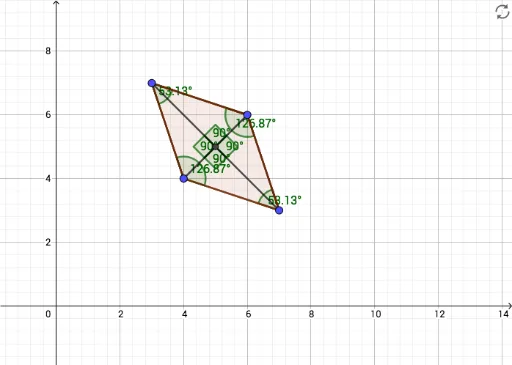
This GeoGebra example demonstrates the construction of a rhombus and explores its relationships with incircles, complex numbers, trapezoids, and cubes. The core mathematical concepts include the definition of a rhombus (all sides equal), properties of diagonals, conditions for an incircle, and the geometric representation of complex numbers. Construction highlights: using commands such as Line, Segment, Point, Polygon, Angle, and Intersect, points A, B, C, D are created, connected by segments f, g, h, etc., to form a quadrilateral; angles α, β, γ, δ are measured to verify rhombus properties; an incircle q1 is constructed, and complex-number-related objects (e.g., a_1, b) are introduced to illustrate the mapping between complex numbers and geometry. Suitable for middle/high school geometry, analytic geometry, or introductory complex number courses, and for exploring the connection between algebra and geometry.
GeoGebra Commands & Parameters
Line(A, B) → fLine(C, f) → gLine(C, f) → hLine(B, h) → iLine(C, i) → jLine(B, j) → kSegment(C, A) → lSegment(A, D) → mSegment(D, B) → nSegment(B, C) → pPoint(n) → ELine(E, l) → qPoint(m) → FLine(F, p) → rSegment(C, A) → sSegment(C, B) → tSegment(B, D) → aPolygon(C, A, D, B) → q1, c, a_1, d, bAngle(q1) → α, β, γ, δSegment(C, D) → eSegment(B, A) → f_1Intersect(e, f_1) → GAngle(C, G, A) → εAngle(A, G, D) → ζAngle(D, G, B) → ηAngle(B, G, C) → θ
AI Drawing Prompt Reference
Draw a rhombus with four vertices connected in order. Start by creating two intersecting lines as guides, then construct the four sides of the rhombus based on these lines. Inside the rhombus, draw a segment from the midpoint of one side to the opposite side, and another segment from the midpoint of an adjacent side to its opposite side; these two segments intersect at the center. Then, construct an incircle tangent to all four sides. Measure the four interior angles to confirm they are equal. Finally, draw the diagonals, mark their intersection point, and measure the four angles formed at that intersection to demonstrate the properties of rhombus diagonals.
The prompt above was compiled from the original drawing commands and is for reference only.