
Refraction on Parallel Surfaces
Loading the math board and drawing, please wait…
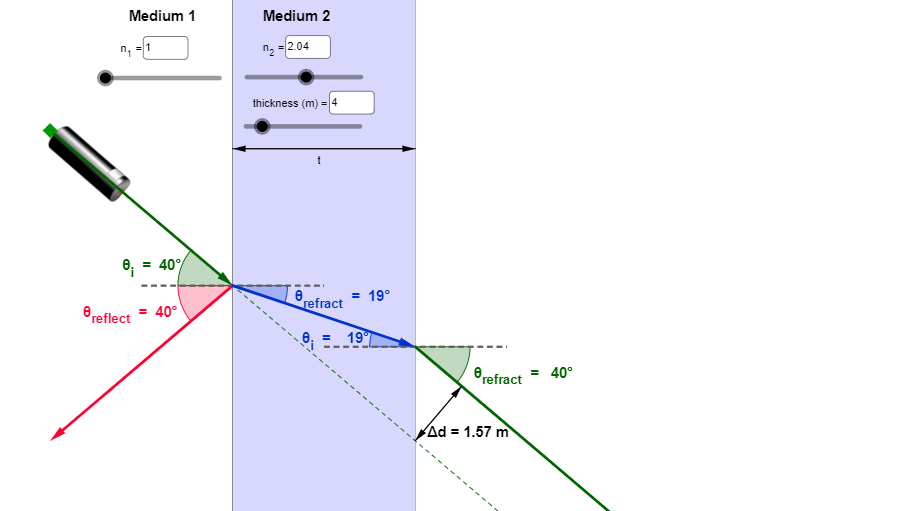
This example demonstrates the phenomenon of light refraction between parallel surfaces. It involves core mathematical concepts such as the law of refraction, geometric mean, sequences and series, and conic sections. Construction highlights include using commands like Point, Line, Intersect, OrthogonalLine, Segment, Angle, If, Rotate, Polygon, Vector, Circle, AngularBisector, Mirror, Textfield, Ray, Distance, Midpoint from GeoGebra. Suitable for high school and above students studying optics and geometric optimization problems.
GeoGebra Commands & Parameters
Point(yAxis) → FPoint(yAxis) → ELine(E, F) → gIntersect(xAxis, yAxis) → DOrthogonalLine(D, g) → hPoint(h) → KSegment(A, B) → fIntersect(h, f) → GPoint(f) → CAngle(G, D, C) → βAngle(C, D, G) → αIf(α > 90°, β, α) → γRotate(K, a, D) → K'Line(D, K') → g_1Polygon(R, S, T, U) → poly2, r, s, t_1, u_1Intersect(g_1, t_1) → VVector(C, D) → uCircle(D, 1.2) → cAngularBisector(C, D, G) → iIntersect(c, i, 2) → HMirror(C, h) → C'Vector(D, C') → vAngularBisector(C', D, G) → jIntersect(c, j, 2) → IAngle(C', D, G) → δAngle(G, D, C') → εIf(δ > 90°, ε, δ) → ζCircle(D, 1.8) → dIntersect(d, j, 2) → JAngle(K, D, K') → ηRotate(K, (-a), D) → K'_1Angle(K'_1, D, K) → θAngularBisector(K'_1, D, K) → kAngularBisector(K, D, K') → lIntersect(c, k, 2) → LIntersect(c, l, 2) → MVector(D, K'_1) → wVector(D, K') → bPolygon(N, O, P, Q) → poly1, n, o, p, qTextfield(n_1) → InputBox1Textfield(n_2) → InputBox2Line(C, D) → mOrthogonalLine(C, m) → f_1Circle(C, 0.6) → eIntersect(e, f_1, 2) → ZIntersect(e, f_1, 1) → A_1Line(D, K'_1) → h_1Intersect(h_1, t_1) → WVector(D, V) → v_1Vector(D, W) → w_1Rotate(B_1, (-γ), W) → C_1Angle(C_1, W, B_1) → νPoint(h) → D_1Point(h) → E_1Segment(D_1, E_1) → i_1Vector(W, C_1) → a_1Rotate(G_1, γ, V) → F_1Angle(G_1, V, F_1) → ξVector(V, F_1) → b_1Ray(C, D) → j_1Segment(H_1, I_1) → k_1Segment(J_1, K_1) → l_1AngularBisector(F_1, V, G_1) → m_1AngularBisector(B_1, W, C_1) → p_1Circle(W, 1) → c_1Circle(V, 1) → d_1Intersect(d_1, m_1, 2) → L_1Intersect(c_1, p_1, 2) → M_1Angle(D, W, J_1) → οAngle(H_1, V, D) → ρAngularBisector(J_1, W, D) → q_1AngularBisector(D, V, H_1) → r_1Intersect(d_1, r_1, 2) → N_1Intersect(c_1, q_1, 2) → O_1Intersect(t_1, j_1) → P_1OrthogonalLine(P_1, j_1) → s_1Line(W, C_1) → e_1Intersect(s_1, e_1) → Q_1Distance(P_1, Q_1) → distanceP1Q1Textfield(t) → InputBox3Midpoint(P_1, Q_1) → R_1Vector(P_1, Q_1) → u_2Vector(Q_1, P_1) → v_2Line(F_1, V) → f_2Intersect(f_2, s_1) → S_1Midpoint(P_1, S_1) → T_1Vector(S_1, P_1) → w_2Vector(P_1, S_1) → a_2Distance(P_1, S_1) → o_1Distance(P_1, S_1) → b_2Point(r) → U_1Point(t_1) → V_1Vector(U_1, V_1) → c_2Vector(V_1, U_1) → d_2