
Reflective Symmetry of a Rhombus
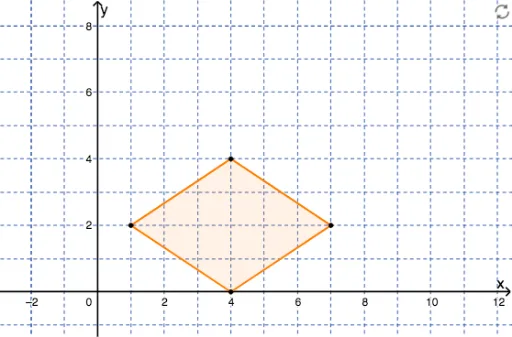
Loading the math board and drawing, please wait…
This example demonstrates the reflective symmetry of a rhombus by dynamically showing how the rhombus overlaps when folded along its diagonals. Key mathematical concepts include symmetry axes, diagonals, polygon properties, and trigonometric functions (sine values). Construction involves commands like Segment, Circle, Point, Line, Intersect, Polygon, and objects such as f, c, d, C, g, h, i, D, poly1, b, a, c_1, d_1 to trace intersections and loci. Suitable for high school mathematics education, combining geometric symmetry with analytical geometry.
GeoGebra Commands & Parameters
Segment(A, B) → fCircle(A, B) → cCircle(B, A) → dPoint(c) → CSegment(A, C) → gLine(C, f) → hLine(B, g) → iIntersect(h, i) → DPolygon(B, A, C, D) → poly1, b, a, c_1, d_1
AI Drawing Prompt Reference
Draw a rhombus and demonstrate its reflective symmetry by showing how it overlaps when folded along its diagonals. Start by constructing the diagonals and finding their intersection point and the points where the diagonals intersect the sides of the rhombus. Use these points to form the rhombus and draw the diagonals. Finally, visualize the rhombus overlapping along the diagonals dynamically to illustrate the symmetry axes and trigonometric functions (sine values).
The prompt above was compiled from the original drawing commands and is for reference only.