
Rectangular Prism Pattern: Geometric Construction and Visualization
Loading the math board and drawing, please wait…
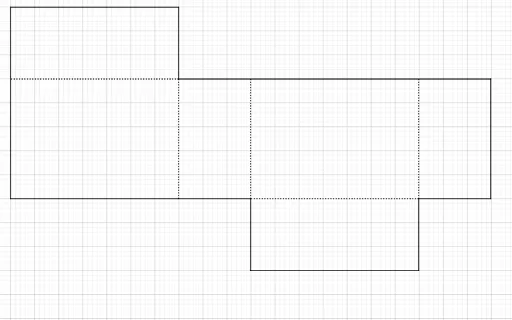
This GeoGebra example demonstrates a rectangular prism (cuboid) pattern, constructed using basic geometric elements such as points and segments to form the wireframe of the prism. The core mathematical concepts involve solid geometry, including the definition of a prism, its vertices, edges, faces, and spatial relationships among points and lines. Although the original tags also mention differential equations, definite integrals, conditional probability, correlation, and continuity, the primary focus here is the geometric construction of the prism. From the construction summary, the commands used are Point and Segment, creating numerous objects labeled A, B, C, D, F, G, h, I, K, k, H, f, i, J, j, l, m, n, p, E, g, q, r, L, s, M, t, a, N, b, which likely represent vertices, edges, and auxiliary points or segments. By connecting these points, the six faces and twelve edges of the cuboid are formed. This resource is suitable for middle and high school students learning solid geometry, as well as for teachers demonstrating prism structures in class, or as an introductory exercise for spatial reasoning and mathematical modeling.
GeoGebra Commands & Parameters
Point(yAxis) → APoint(yAxis) → DSegment(G, F) → hSegment(K, I) → kSegment(H, C) → fSegment(H, K) → iSegment(I, J) → jSegment(J, F) → lSegment(C, D) → mSegment(D, A) → nSegment(A, B) → pSegment(G, E) → gSegment(B, E) → qSegment(E, C) → rPoint(g) → LSegment(L, H) → sSegment(J, M) → tSegment(J, H) → aSegment(E, N) → b