
Real World Parabola Project: Modeling Parabolas in Everyday Life
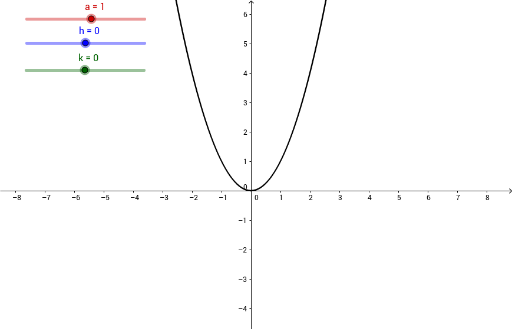
Loading the math board and drawing, please wait…
①This example demonstrates how to model real-world parabolic phenomena (such as fountains, arch bridges, projectile paths) as mathematical functions and visualize them dynamically in GeoGebra. ②The core mathematical concept is the quadratic function (parabola) in vertex form y=a(x-h)²+k, where parameter a controls the opening direction and width, and the vertex (h,k) determines position; it also touches on median value, exponent, trigonometry, and matrices as extended topics, but the focus is on parabolas. ③Construction details: the summary lists objects a, h, k, and c, where a, h, k are key parameters of the standard parabola equation, and c may represent a constant or auxiliary object; by adjusting these parameters via sliders or input boxes, learners can observe real-time changes in the parabola's shape and position, thereby understanding the effect of each parameter. ④This is suitable for middle and high school students learning quadratic functions, and also for mathematical modeling or project-based learning, helping students connect abstract algebra with intuitive geometry and enhance their ability to solve practical problems.
GeoGebra Commands & Parameters
Numeric a(1)Numeric h(0)Numeric k(0)y = (a * (x - h)^(2)) + k