
Quadrilateral Predictions
Loading the math board and drawing, please wait…
In collections
Elementary Geometry
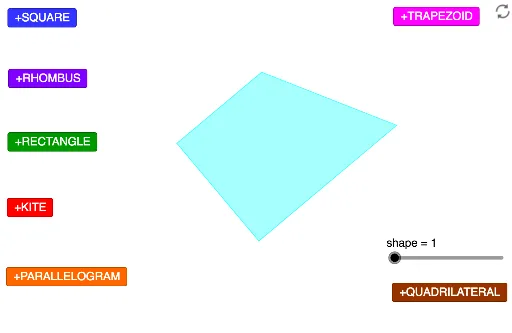
This example demonstrates geometric properties and predictions of quadrilaterals. It involves core concepts like polygons, circumcircle, incircle, and prism. Construction uses commands such as Polygon, Point, Intersect, Mirror, OrthogonalLine, Circle. Suitable for high school mathematics education to understand the geometric relationship between quadrilaterals and circles.
GeoGebra Commands & Parameters
Polygon(A, B, 4) → poly1, f, g, h, i, C, DPolygon(A_1, B_1, 4) → poly1_1, f_1, g_1, h_1, i_1, C_1, D_1Polygon(A_2, B_2, 4) → poly1_2, f_2, g_2, h_2, i_2, C_2, D_2Polygon(A_3, B_3, 4) → poly1_3, f_3, g_3, h_3, i_3, C_3, D_3Polygon(A_4, B_4, 4) → poly1_4, f_4, g_4, h_4, i_4, C_4, D_4Polygon(A_5, B_5, 4) → poly1_5, f_5, g_5, h_5, i_5, C_5, D_5Polygon(A_6, B_6, 4) → poly1_6, f_6, g_6, h_6, i_6, C_6, D_6Polygon(A_7, B_7, 4) → poly1_7, f_7, g_7, h_7, i_7, C_7, D_7Point(CircleArc[E, Rotate[F, -1°, E], Rotate[F, (-(179°)), E]]) → GIntersect(Circle[G, E], Circle[F, E]) → H, I, ,Polygon(E, F, I, G) → q1, e, f_8, i_8, g_8Point(CircleArc[E_1, Rotate[F_1, -1°, E_1], Rotate[F_1, (-(179°)), E_1]]) → G_1Intersect(Circle[G_1, E_1], Circle[F_1, E_1]) → H_1, I_1, ,Polygon(E_1, F_1, I_1, G_1) → q1_1, e_1, f_9, i_9, g_9Point(CircleArc[E_2, Rotate[F_2, -1°, E_2], Rotate[F_2, (-(179°)), E_2]]) → G_2Intersect(Circle[G_2, E_2], Circle[F_2, E_2]) → H_2, I_2, ,Polygon(E_2, F_2, I_2, G_2) → q1_2, e_2, f_{10}, i_{10}, g_{10}Point(CircleArc[E_3, Rotate[F_3, -1°, E_3], Rotate[F_3, (-(179°)), E_3]]) → G_3Intersect(Circle[G_3, E_3], Circle[F_3, E_3]) → H_3, I_3, ,Polygon(E_3, F_3, I_3, G_3) → q1_3, e_3, f_{11}, i_{11}, g_{11}Point(CircleArc[E_4, Rotate[F_4, -1°, E_4], Rotate[F_4, (-(179°)), E_4]]) → G_4Intersect(Circle[G_4, E_4], Circle[F_4, E_4]) → H_4, I_4, ,Polygon(E_4, F_4, I_4, G_4) → q1_4, e_4, f_{12}, i_{12}, g_{12}Point(CircleArc[E_5, Rotate[F_5, -1°, E_5], Rotate[F_5, (-(179°)), E_5]]) → G_5Intersect(Circle[G_5, E_5], Circle[F_5, E_5]) → H_5, I_5, ,Polygon(E_5, F_5, I_5, G_5) → q1_5, e_5, f_{13}, i_{13}, g_{13}Point(CircleArc[E_6, Rotate[F_6, -1°, E_6], Rotate[F_6, (-(179°)), E_6]]) → G_6Intersect(Circle[G_6, E_6], Circle[F_6, E_6]) → H_6, I_6, ,Polygon(E_6, F_6, I_6, G_6) → q1_6, e_6, f_{14}, i_{14}, g_{14}Point(CircleArc[E_7, Rotate[F_7, -1°, E_7], Rotate[F_7, (-(179°)), E_7]]) → G_7Intersect(Circle[G_7, E_7], Circle[F_7, E_7]) → H_7, I_7, ,Polygon(E_7, F_7, I_7, G_7) → q1_7, e_7, f_{15}, i_{15}, g_{15}Point(OrthogonalLine[J, Line[J, K]]) → MPolygon(J, K, N, M) → q2, j, k, n, mPoint(OrthogonalLine[J_1, Line[J_1, K_1]]) → M_1Polygon(J_1, K_1, N_1, M_1) → q2_1, j_1, k_1, n_1, m_1Point(OrthogonalLine[J_2, Line[J_2, K_2]]) → M_2Polygon(J_2, K_2, N_2, M_2) → q2_2, j_2, k_2, n_2, m_2Point(OrthogonalLine[J_3, Line[J_3, K_3]]) → M_3Polygon(J_3, K_3, N_3, M_3) → q2_3, j_3, k_3, n_3, m_3Mirror(Q, Line[O, P]) → Q'Polygon(O, Q, P, Q') → q3, o, q, p, q'Mirror(Q_1, Line[O_1, P_1]) → Q'_1Polygon(O_1, Q_1, P_1, Q'_1) → q3_1, o_1, q_1, p_1, q'_1Mirror(Q_2, Line[O_2, P_2]) → Q'_2Polygon(O_2, Q_2, P_2, Q'_2) → q3_2, o_2, q_2, p_2, q'_2Mirror(Q_3, Line[O_3, P_3]) → Q'_3Polygon(O_3, Q_3, P_3, Q'_3) → q3_3, o_3, q_3, p_3, q'_3Polygon(S, U, T, R) → q4, s, u, t, rPolygon(S_1, U_1, T_1, R_1) → q4_1, s_1, u_1, t_1, r_1Polygon(S_2, U_2, T_2, R_2) → q4_2, s_2, u_2, t_2, r_2Polygon(S_3, U_3, T_3, R_3) → q4_3, s_3, u_3, t_3, r_3Point(Ray[Z, Z + W - V]) → L_1Polygon(V, W, L_1, Z) → q5, v, w, l_1, z_1Point(Ray[Z_1, Z_1 + W_1 - V_1]) → L_2Polygon(V_1, W_1, L_2, Z_1) → q5_1, v_1, w_1, l_2, z_2Point(Ray[Z_2, Z_2 + W_2 - V_2]) → L_3Polygon(V_2, W_2, L_3, Z_2) → q5_2, v_2, w_2, l_3, z_3Point(Ray[Z_3, Z_3 + W_3 - V_3]) → L_4Polygon(V_3, W_3, L_4, Z_3) → q5_3, v_3, w_3, l_4, z_4Polygon(J_4, K_4, M_4, N_4) → q6, j_4, k_4, m_4, n_4Polygon(J_5, K_5, M_5, N_5) → q6_1, j_5, k_5, m_5, n_5Polygon(J_6, K_6, M_6, N_6) → q6_2, j_6, k_6, m_6, n_6Polygon(J_7, K_7, M_7, N_7) → q6_3, j_7, k_7, m_7, n_7OrthogonalLine(P_4, Line[O_4, P_4]) → lPoint(l) → Q_4OrthogonalLine(O_4, Line[O_4, P_4]) → aPoint(a) → R_4Polygon(O_4, P_4, Q_4, R_4) → q7, o_4, p_4, q_4, r_4Polygon(U_4, T_4, V_4, S_4) → q8, u_4, t_4, v_4, s_4Circle(W_4, Z_4) → cPoint(c) → L_5Circle(L_5, W_4) → dCircle(Z_4, W_4) → c_1Intersect(d, c_1, 2) → O_5Polygon(L_5, O_5, Z_4, W_4) → q9, l_5, o_5, z_5, w_4Polygon(P_5, Q_5, 4) → poly2, b, a_1, b_1, d_1, R_5, S_5Point(Ray[U_5, Rotate[T_5, (-(90°)), U_5]]) → V_5Polygon(T_5, U_5, V_5, W_5) → q10, t_5, u_5, v_5, w_5