
Quadrilateral and Nested Inner Quadrilaterals Construction
Loading the math board and drawing, please wait…
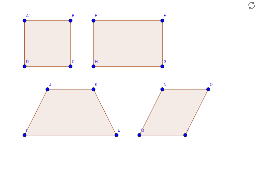
① This GeoGebra example demonstrates a quadrilateral (poly1) and its successively nested inner quadrilaterals (poly2, poly3, poly4), visually showing the geometric phenomenon of continuous polygon construction. ② Core mathematical concepts include polygon properties, quadrilateral classifications (rectangle, square, trapezoid), and midpoint-connection figures, while also touching on sequences and series (e.g., recursive relations of areas or side lengths), hypergeometric distribution, expected value, and median lines—though the primary geometric focus is on vertex and edge construction. ③ Construction highlights: from the summary, the Polygon command is used to create four polygons sequentially, with objects including vertices A, B, C, D and sides (a, b, c, d, etc.), and points E through P (likely midpoints or intersections) generating inner polygons, illustrating a step-by-step geometric construction based on existing objects. ④ Suitable for middle/high school geometry teaching, math labs, or inquiry-based learning, helping students understand nested polygon relationships and midpoint quadrilateral properties, while also serving as an interdisciplinary example linking geometry with statistics.
GeoGebra Commands & Parameters
Polygon(A, B, C, D) → poly1, a, b, c, dPolygon(E, F, G, H) → poly2, e, f, g, hPolygon(I, J, K, L) → poly3, i, j, k, lPolygon(M, N, O, P) → poly4, m, n, o, p
AI Drawing Prompt Reference
Draw a quadrilateral, then connect the midpoints of its four sides to form a second inner quadrilateral. Repeat this process: connect the midpoints of the second quadrilateral's sides to create a third inner quadrilateral, and then do it once more to obtain a fourth inner quadrilateral. The result is a series of nested quadrilaterals, each smaller and inside the previous one, demonstrating the midpoint-connection pattern.
The prompt above was compiled from the original drawing commands and is for reference only.