
Pythagorean Tiling by John Golden
Loading the math board and drawing, please wait…
In collections
Pythagorean Theorem
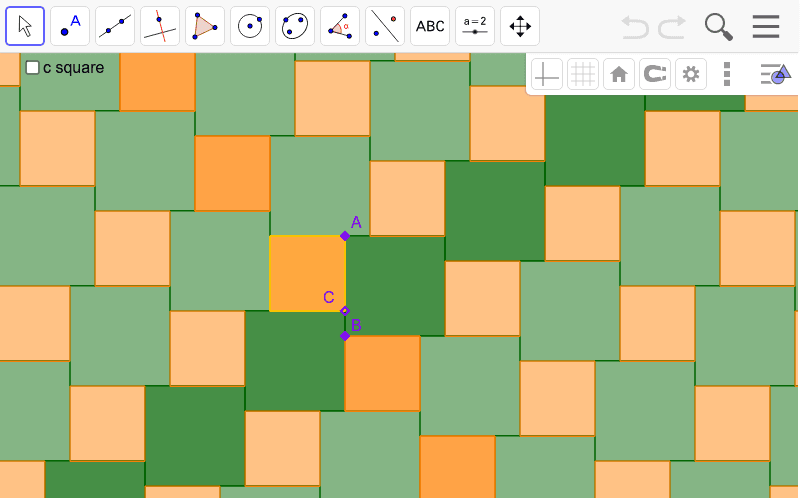
This example demonstrates the application of the Pythagorean theorem in plane geometry through dynamic tilings, showing the relationship between right triangles and integer side lengths. Key math concepts include right triangles, Pythagorean theorem, integer side lengths, and tiling construction. GeoGebra commands used in construction are Polygon, Point, Vector, Circle, Intersect, Sequence, and Translate. Suitable for high school mathematics teaching, helping students understand geometric construction and sequence applications.
GeoGebra Commands & Parameters
Polygon(A, B, 4) → poly1, a, b, c, d, C_1, DPoint(a) → CPolygon(C, A, 4) → poly2, e, f, g, h, F, GVector(D, C) → uCircle(B, e) → kIntersect(k, b, 1) → HVector(A, H) → vSequence(Translate[poly1, Vector[i * u]], i, -4, 4) → list1Sequence(Translate[list1, Vector[i * v]], i, -4, 4) → list2Sequence(Translate[poly2, Vector[i * v]], i, -4, 4) → list3Sequence(Translate[list3, Vector[i * u]], i, -4, 4) → list4Translate(A, u) → A'Polygon(A, A', 4) → poly3, i, j, l, m, I, JSequence(Translate[poly3, Vector[i * u]], i, -4, 4) → list5Sequence(Translate[list5, Vector[i * v]], i, -4, 4) → list6
AI Drawing Prompt Reference
Draw a Pythagorean tiling pattern composed of multiple congruent right triangles. Start by creating a right triangle with integer side lengths, then use vector and translation commands to generate a series of the same triangles. Arrange them through translation and rotation to form a complex tiling pattern, ensuring each triangle adheres to the Pythagorean theorem.
The prompt above was compiled from the original drawing commands and is for reference only.