
Pythagorean Theorem Wordless Proof (20): Rotation, Reflection, and Reassembly
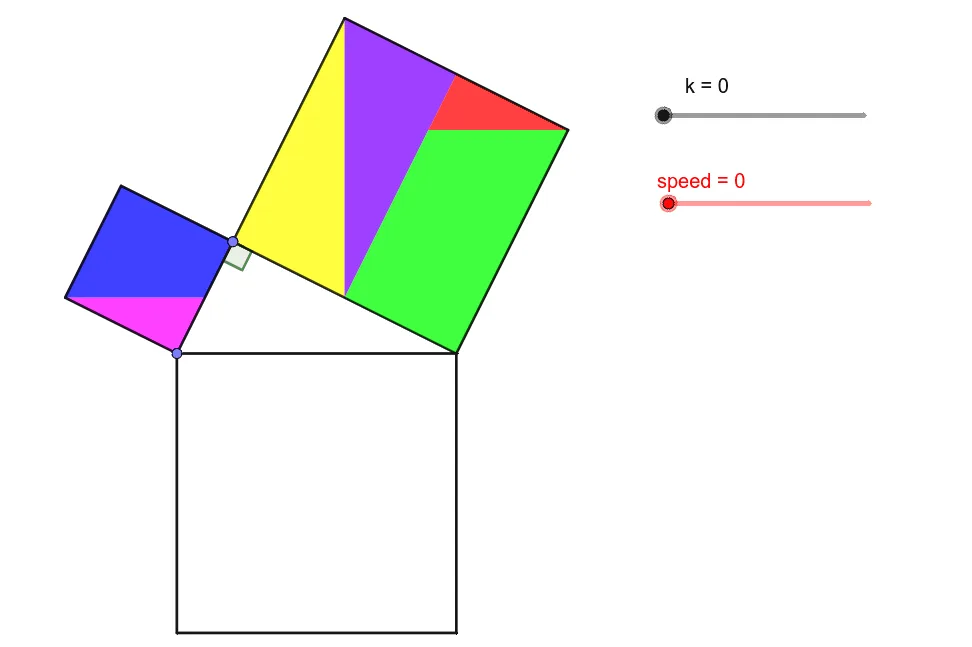
This example provides a wordless geometric demonstration of the Pythagorean theorem by using a sequence of transformations—rotation, reflection (mirroring), and translation—to build polygonal regions whose areas can be matched visually. It focuses on a right-triangle setting and the identity a^2 + b^2 = c^2 via area invariance under rigid motions, emphasizing the idea of decomposing and reassembling regions without changing their total area. Construction-wise, it uses GeoGebra commands such as Intersect to determine key intersection points, Point to create and manage vertices (e.g., O, A, B, C and additional auxiliary points), Mirror to generate reflected copies, Translate to shift figures for alignment, Polygon to form the composite regions (poly1, poly2, poly3), If to select or control conditional construction steps, and Angle to maintain or reference the required angular relationships. The resulting matched polygon partitions make the theorem’s area correspondence easy to see. Suitable for middle and high school geometry instruction, classroom demonstrations, and review materials on geometric transformations and Euclidean constructions.
Loading the math board and drawing, please wait…