
Pythagorean Theorem Proof by Andrew Knauft
Loading the math board and drawing, please wait…
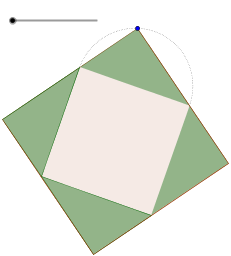
This example demonstrates the proof of the Pythagorean Theorem, which states that in a right-angled triangle, the square of the hypotenuse is equal to the sum of the squares of the other two sides. Using GeoGebra commands such as Semicircle, Point, Polygon, Rotate, etc., the construction shows that the area of the semicircle on the hypotenuse is equal to the sum of the areas of the semicircles on the other two sides. Suitable for students at the junior high school level and above for learning geometric proofs.
GeoGebra Commands & Parameters
Semicircle(B, A) → kPoint(k) → CPolygon(C, Translate[Rotate[A, ((-π)) / 2, C], Vector[C, B]], 4) → poly6, m, n, p, q, F, GRotate(Translate[A, Vector[C, G]], ((-π)) / 2, G) → A'Polygon(B, C, A) → poly1, a, b, cAngle(C, A, B) → βPolygon(A, G, A') → poly4, h, i, jRotate(Polygon[Translate[B, Vector[A, B]], Translate[C, Vector[A, B]], Translate[A, Vector[A, B]]], α' - π, B) → poly3Rotate(Polygon[Translate[A, Vector[A, A']], Translate[G, Vector[A, A']], Translate[A', Vector[A, A']]], π - α', A') → poly5Segment(A, Translate[A, Vector[G, F]]) → d