
Pythagorean Theorem Proof #6
Loading the math board and drawing, please wait…
In collections
GCSE Higher Ch5 Angles & Trigonometry
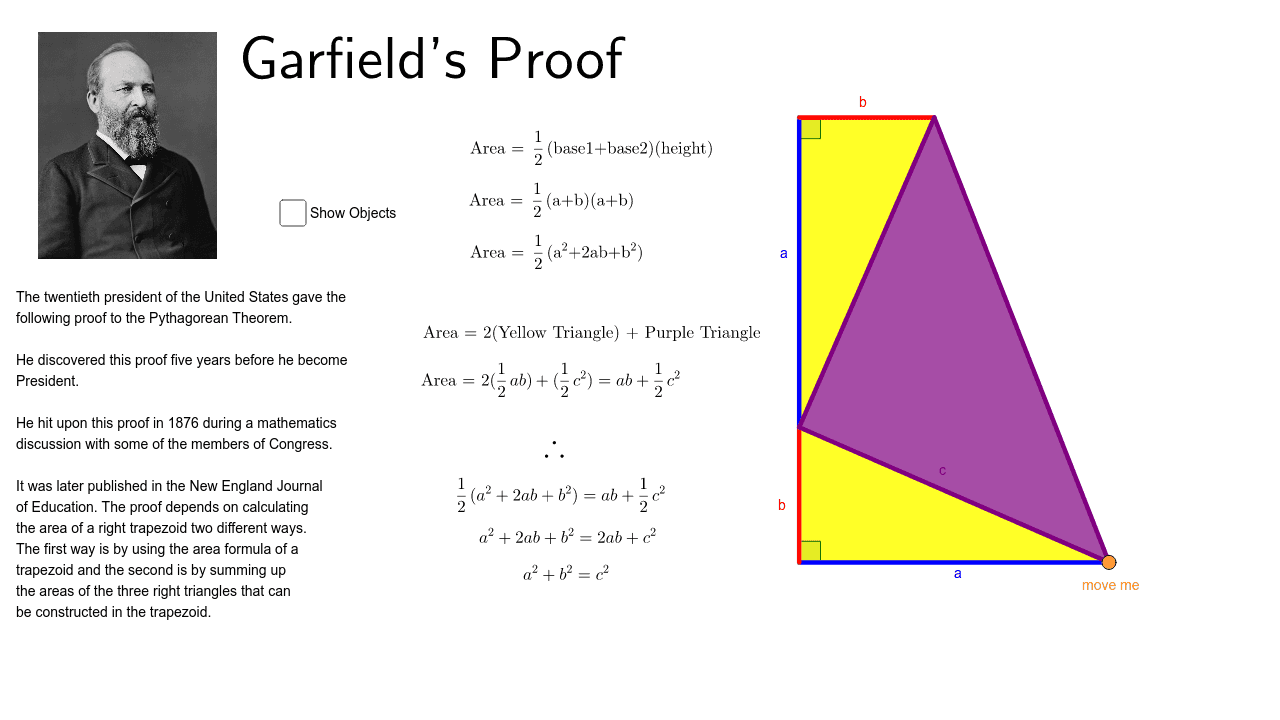
This example demonstrates the proof of the Pythagorean Theorem. It involves core concepts of triangles and geometric construction. Using GeoGebra commands such as point, segment, polygon, circle, and intersection, a dynamic geometric model is constructed. Suitable for middle school and above students to learn geometric proofs and dynamic geometry.
GeoGebra Commands & Parameters
Point(m) → BPoint(m) → ASegment(A, B) → aPolygon(A, B, 4) → poly1, b, c, d, e, C, DPoint(a) → ECircle(A, E) → fSegment(A, E) → gCircle(D, g) → hIntersect(h, e, 1) → FPolygon(F, E, 4) → poly2, i, j, k, l, G, HSegment(A, E) → nIntersect(d, e) → IIntersect(d, k) → JIntersect(c, d) → KIntersect(c, j) → LSegment(F, I) → pSegment(J, K) → qSegment(L, B) → rSegment(A, F) → sSegment(I, J) → tSegment(K, L) → a_1Segment(E, B) → b_1Segment(F, E) → c_1Segment(F, J) → d_1Segment(J, L) → e_1Segment(E, L) → f_1Angle(I, A, B) → αIntersect(c, d) → MAngle(A, I, M) → βAngle(I, M, B) → γAngle(M, B, A) → δSegment(J, E) → g_1Polygon(E, A, F) → poly3, f_2, e_2, a_2Polygon(F, J, I) → poly4, i_1, f_3, j_1Polygon(J, K, L) → poly5, l_1, j_2, k_1Polygon(L, B, E) → poly6, e_3, l_2, b_2Polygon(F, J, E) → poly7, e_4, f_4, j_3Polygon(E, L, J) → poly8, j_4, e_5, l_3
AI Drawing Prompt Reference
Draw a right triangle ABC with points A and B as the endpoints of the legs and point C as the endpoint of the hypotenuse. Construct a circle centered at A with radius AE, and another circle centered at D with radius DG, which intersect at point F. Connect points A, E, F, I, J, K, and L to form several triangles and quadrilaterals, illustrating the proof of the Pythagorean theorem.
The prompt above was compiled from the original drawing commands and is for reference only.