
Pythagorean Theorem by dodorieneken
Loading the math board and drawing, please wait…
In collections
Derde jaar
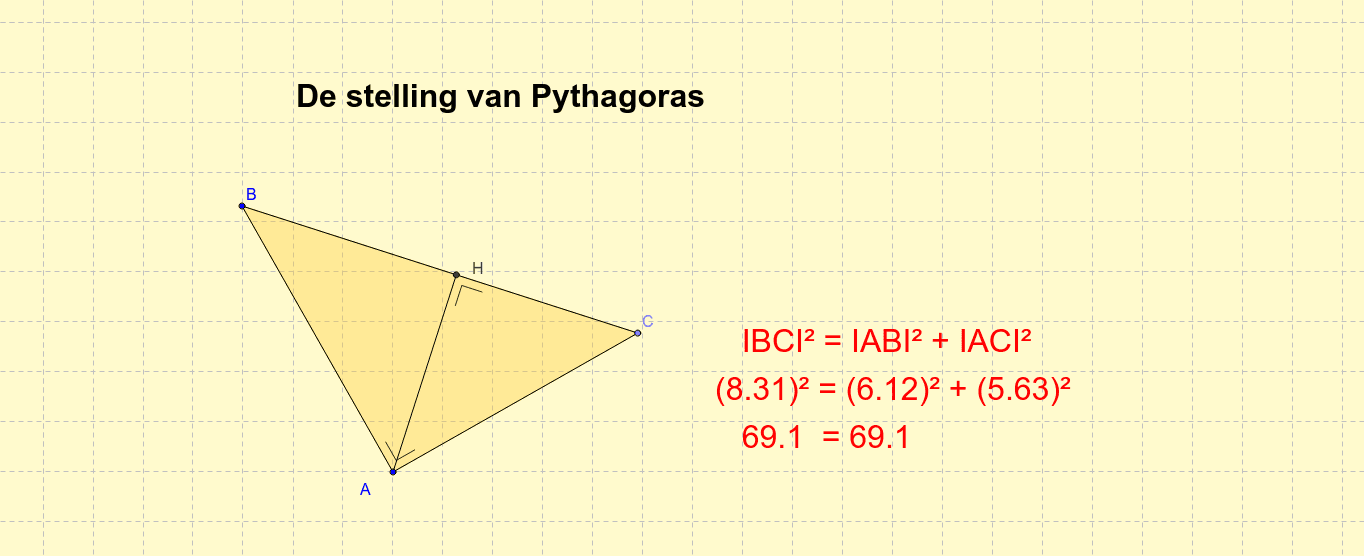
This example illustrates the Pythagorean Theorem, which states that in a right-angled triangle, the square of the hypotenuse is equal to the sum of the squares of the other two sides. It involves key mathematical concepts such as right-angled triangles, rotation, lines, and angles. Using GeoGebra commands like Rotate, Line, Point, and Polygon, the proof process can be dynamically demonstrated. Suitable for middle school and above students to learn and explore.
GeoGebra Commands & Parameters
Rotate(B, 270*°, A) → A'Angle(A', A, B) → αLine(B, A) → aLine(A, A') → bPoint(b) → CPolygon(B, A, C) → veelhoek1, c, a_1, b_1OrthogonalLine(A, b_1) → dIntersect(d, b_1) → DSegment(A, D) → eIntersect(b_1, d) → HSegment(B, A) → fSegment(A, C) → gSegment(C, B) → hAngle(A, H, C) → β
AI Drawing Prompt Reference
Draw a right-angled triangle with labeled legs and hypotenuse. Rotate one leg 90 degrees counterclockwise around the right angle vertex to form a new line. Create a new triangle using this line and the other leg. In the new triangle, draw a line parallel to the original leg, intersecting the other side. Connect the right angle vertex to the intersection point, forming two smaller triangles. Label the areas of the large triangle and the two smaller triangles to demonstrate the Pythagorean theorem.
The prompt above was compiled from the original drawing commands and is for reference only.