
Pythagorean Theorem Auxiliary Theorem
Loading the math board and drawing, please wait…
In collections
Derde jaar
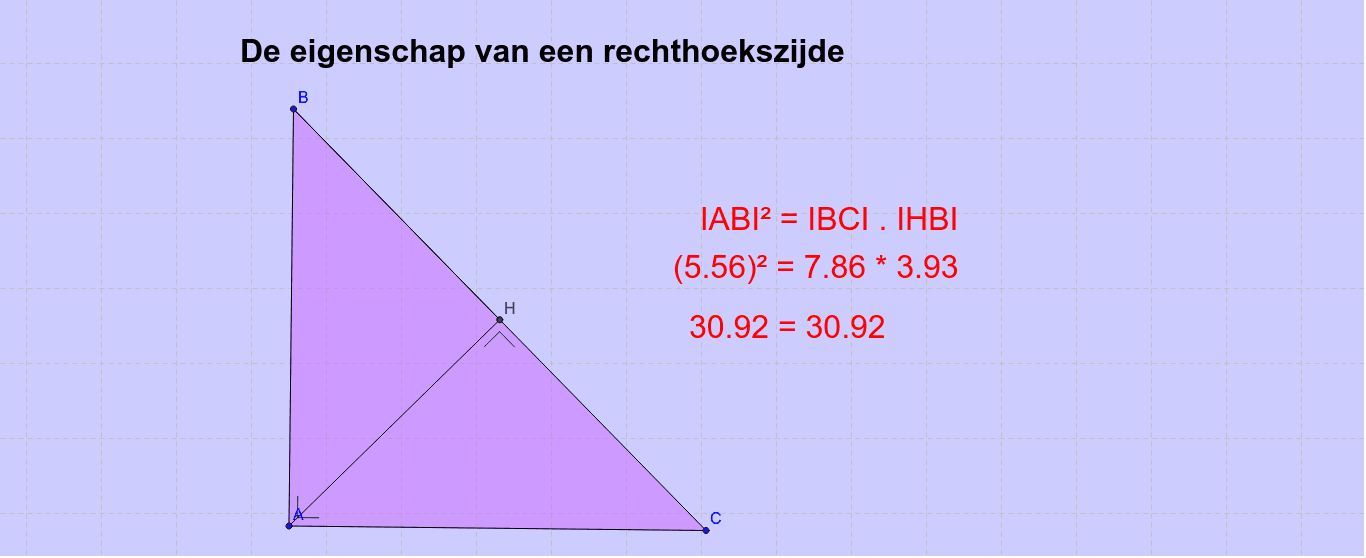
This example illustrates the auxiliary theorem of the Pythagorean theorem, which states that the altitude of the hypotenuse of a right triangle divides the hypotenuse into two segments that are proportional to the lengths of the original triangle's legs. Key mathematical concepts include right triangles, the Pythagorean theorem, and its auxiliary theorem. It is constructed using GeoGebra commands such as rotation, polygon, orthogonal line, intersection, and segment. Suitable for students in middle school and above for geometric construction.
GeoGebra Commands & Parameters
Rotate(C, 90*°, A) → BAngle(C, A, B) → αPolygon(C, A, B) → veelhoek1, a', a, bOrthogonalLine(A, b) → cIntersect(b, c) → HAngle(A, H, C) → βSegment(A, H) → dSegment(A, B) → eSegment(B, H) → fSegment(B, C) → gSegment(A, C) → h
AI Drawing Prompt Reference
Draw a right triangle ABC with AB as the hypotenuse. Construct a perpendicular from C to AB, intersecting at H. Form right triangles ACH and BCH, and measure and display the angles ∠A and ∠B. Draw the segments AH, BH, CH, AB, BC, and AC to illustrate the geometric relationships in the auxiliary theorem.
The prompt above was compiled from the original drawing commands and is for reference only.