
Pythagorean Theorem and Similarity for a Geometry Practice (GeoGebra)
Loading the math board and drawing, please wait…
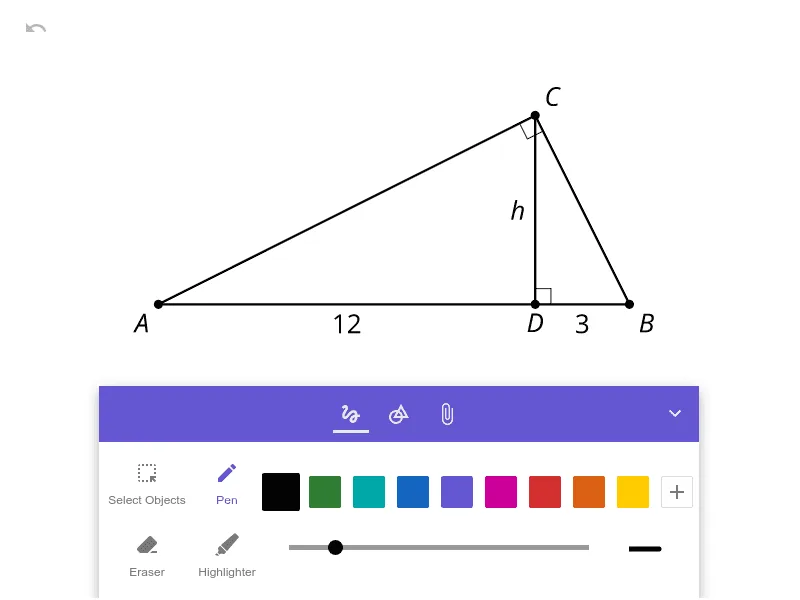
This example demonstrates how to solve and visually verify length relationships in plane geometry by combining the Pythagorean Theorem with similarity of triangles. It centers on core ideas such as the Pythagorean Theorem in right triangles, similarity-based proportional reasoning between corresponding sides, and how geometric quantities can be linked to trigonometric relationships (e.g., tangent as a ratio tied to angles). Construction-wise, starting from the geometric scene (object: pic1), it builds the relevant right-triangle configuration, applies similarity to relate unknown lengths via side ratios, and then uses the Pythagorean Theorem to compute or confirm certain side lengths. The resulting figure supports step-by-step interpretation and checking. Suitable for middle/high school geometry practice, exam review, and interactive classroom demonstrations focused on “similarity + Pythagorean” problem solving.
AI Drawing Prompt Reference
Draw a right triangle and use the proportional relationships between similar triangles to represent unknown side lengths. Then apply the Pythagorean theorem to compute or verify certain side lengths. The figure should include a right triangle, the proportional relationships derived from similar triangles, and the application of the Pythagorean theorem to solve or confirm side lengths.
The prompt above was compiled from the original drawing commands and is for reference only.