
Pythagorean Tessellation #133 Tiling
Loading the math board and drawing, please wait…
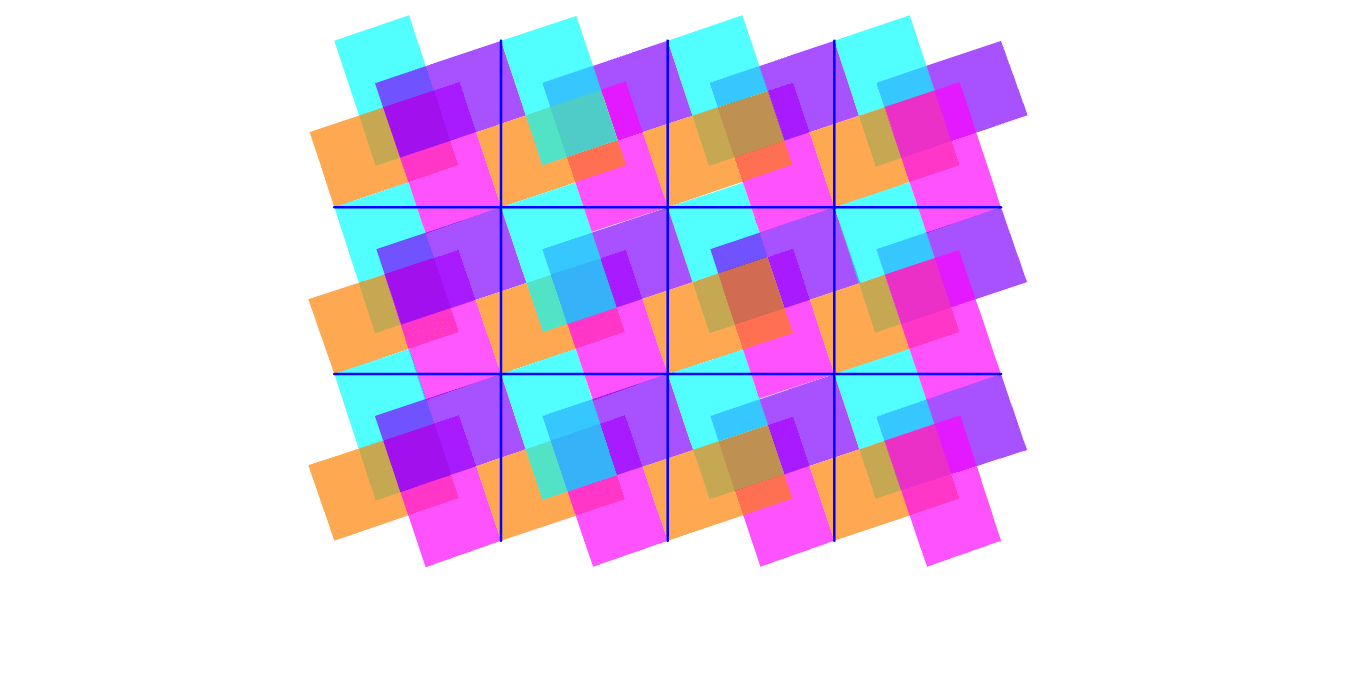
This example demonstrates the Pythagorean Theorem through tessellation, visually illustrating the relationship between the sides of a right triangle. Core mathematical concepts include the Pythagorean Theorem, circumcircle, geometric mean, tree diagrams, root calculations, and standard deviation. The construction utilizes GeoGebra commands and objects such as Line, Point, OrthogonalLine, Segment, Rotate, Angle, Intersect, and Polygon. Suitable for high school mathematics education to enhance understanding of the Pythagorean Theorem and geometric constructions.
GeoGebra Commands & Parameters
Line(A, B) → aLine(C, D) → bPoint(b) → EPoint(b) → FOrthogonalLine(E, b) → cOrthogonalLine(D, b) → dPoint(c) → GPoint(c) → HOrthogonalLine(H, c) → ePoint(c) → IPoint(c) → JPoint(c) → KPoint(c) → LPoint(d) → MLine(J, M) → fPoint(d) → NLine(K, N) → gPoint(d) → OLine(L, O) → hPoint(f) → PLine(C, P) → iPoint(d) → QPoint(d) → RPoint(d) → SPoint(i) → TLine(Q, T) → jPoint(i) → ULine(R, U) → kPoint(i) → VLine(S, V) → lPoint(j) → WPoint(h) → ZLine(W, Z) → mPoint(j) → A_1Point(h) → B_1Line(A_1, B_1) → nPoint(e) → C_1Point(g) → D_1Point(c) → E_1Point(d) → F_1Segment(H, G_1) → pRotate(H, 270*°, G_1) → H'Angle(H', G_1, H) → αSegment(G_1, H') → qSegment(H_1, D_1) → rSegment(O, H_1) → sSegment(I_1, N) → tSegment(I_1, C_1) → a_1Segment(J_1, C_1) → b_1Segment(J_1, E) → c_1Segment(K_1, H) → d_1Segment(K_1, L_1) → e_1Segment(L_1, C) → f_1Segment(M_1, D) → g_1Point(c) → N_1Segment(M_1, N_1) → h_1Intersect(d, e) → O_1Segment(O_1, P_1) → i_1Point(b) → Q_1Segment(P_1, Q_1) → j_1Segment(R_1, N_1) → k_1Segment(R_1, E) → l_1Segment(D, S_1) → m_1Segment(S_1, Q_1) → n_1Point(e_1) → T_1Segment(T_1, O_1) → p_1Segment(U_1, O_1) → q_1Segment(U_1, V_1) → r_1Segment(V_1, H) → s_1Segment(W_1, K) → t_1Segment(Z_1, W_1) → a_2Intersect(e, i) → A_2Segment(A_2, Z_1) → b_2Segment(B_2, O_1) → c_2Segment(C_2, B_2) → d_2Intersect(h, i) → D_2Segment(D_2, C_2) → e_2Segment(E_2, K) → f_2Segment(E_2, F_2) → g_2Segment(F_2, Q) → h_2Segment(O, G_2) → i_2Point(c) → H_2Segment(G_2, H_2) → j_2Segment(L, I_2) → k_2Point(j) → J_2Segment(I_2, J_2) → l_2Segment(L, K_2) → m_2Segment(K_2, L_2) → n_2Intersect(g, i) → M_2Segment(L_2, M_2) → p_2Intersect(b_1, h_1) → N_2Polygon(R_1, E, J_1, N_2) → poly1, r_2, e_3, j_3, n_3Intersect(h_1, j_1) → O_2Polygon(M_1, O_2, S_1, D) → poly2, m_3, o_2, s_2, d_3Intersect(e_1, j_1) → P_2Polygon(P_1, P_2, T_1, O_1) → poly3, p_3, p_4, t_2, o_1Intersect(b_1, e_1) → Q_2Intersect(p, a_1) → R_2Polygon(H, K_1, Q_2, R_2) → poly4, h_3, k_3, q_2, r_3Intersect(q, a_2) → S_2Intersect(r, f_2) → T_2Polygon(K, W_1, S_2, T_2) → poly5, k_4, w_1, s_3, t_3Point(a_2) → U_2Intersect(a_1, a_2) → V_2Polygon(N, U_2, V_2, I_1) → poly6, n_4, u_2, v_2, i_3Intersect(b_1, i_1) → W_2Intersect(a_1, r_1) → Z_2Polygon(W_2, O_1, U_1, Z_2) → poly7, w_2, o_3, u_1, z_2Intersect(q, r_1) → A_3Polygon(V_1, A_3, S_2, G_1, H) → poly8, v_1, a_3, s_4, g_3, h_4Point(n_2) → B_3Intersect(r, n_2) → C_3Polygon(O, B_3, C_3, H_1) → poly9, o, b_3, c_3, h_5Intersect(g_2, n_2) → D_3Intersect(g_2, k_2) → E_3Polygon(D_3, E_3, L, K_2) → poly10, d_4, e_4, l_3, k_5Segment(N, F_3) → f_3Point(c) → G_3Segment(G_3, F_3) → q_3Segment(H_3, G_3) → a_4Segment(K, H_3) → b_4Point(g_2) → I_3Polygon(H_3, I_3, E_2, K) → poly11, h_6, i_4, e_5, k_6Point(r) → J_3Intersect(q, t) → K_3Polygon(J_3, K_3, N, F_3) → poly12, j_4, k_7, n_5, f_4Intersect(c, j) → L_3Segment(L_3, M_3) → c_4Segment(M_3, N_3) → g_4Segment(N_3, Q) → l_4Segment(J_2, O_3) → m_4Segment(O_3, L_3) → q_4Segment(H_2, P_3) → r_4Segment(P_3, L) → t_4Intersect(l_2, g_4) → Q_3Polygon(L_3, M_3, Q_3, O_3) → poly13, l_5, m_5, q_5, o_4Intersect(j_2, l_2) → R_3Polygon(P_3, R_3, I_2, L) → poly14, p_5, r_5, i_5, l_6Intersect(g_2, j_2) → S_3Intersect(s, g_2) → T_3Polygon(S_3, T_3, O, G_2) → poly15, s_5, t_5, o_5, g_5Intersect(g_2, g_4) → U_3Polygon(N_3, Q, F_2, U_3) → poly16, n_6, q_6, f_5, u_3Segment(D, V_3) → a_5Segment(V_3, W_3) → b_5Segment(W_3, M_2) → c_5Segment(O_1, Z_3) → d_5Point(i) → A_4Segment(Z_3, A_4) → j_5Segment(A_2, B_4) → a_6Point(b) → C_4Segment(B_4, C_4) → b_6Segment(C_4, D_4) → c_6Segment(D_4, C) → d_6Segment(A_4, E_4) → e_6Segment(E_4, A_2) → f_6Segment(N, F_4) → g_6Segment(F_4, G_4) → i_6Segment(G_4, M_2) → j_6Segment(O, H_4) → m_6Point(i) → I_4Segment(H_4, I_4) → p_6Segment(N, J_4) → r_6Segment(J_4, K_4) → s_6Segment(K_4, T) → t_6Intersect(e_1, g_1) → L_4Intersect(e_1, b_5) → M_4Polygon(L_4, D, V_3, M_4) → poly17, l_7, d_7, v_3, m_7Intersect(e_1, b_6) → N_4Polygon(D_4, C, L_1, N_4) → poly18, d_8, c_7, l_8, n_7Intersect(j_5, b_6) → O_4Polygon(E_4, A_2, B_4, O_4) → poly19, e_7, a_7, b_7, o_6Intersect(b_5, j_5) → P_4Intersect(c_2, b_5) → Q_4Polygon(O_1, Z_3, P_4, Q_4) → poly20, o_7, z_3, p_7, q_7Intersect(b_5, a_6) → R_4Intersect(a_2, b_5) → S_4Polygon(R_4, A_2, Z_1, S_4) → poly21, r_7, a_8, z_1, s_7Intersect(b_5, i_6) → T_4Polygon(G_4, M_2, W_3, T_4) → poly22, g_7, m_8, w_3, t_7Intersect(d_2, i_6) → U_4Intersect(d_2, r_6) → V_4Polygon(N, F_4, U_4, V_4) → poly23, n_8, f_7, u_4, v_4Intersect(q_1, a_2) → W_4Intersect(a_2, d_2) → Z_4Polygon(W_4, O_1, B_2, Z_4) → poly24, w_4, o_8, b_8, z_4Intersect(d_2, c_5) → A_5Intersect(d_2, n_2) → B_5Polygon(A_5, B_5, L_2, M_2) → poly25, a_9, b_9, l_9, m_9Intersect(d_2, p_6) → D_5Polygon(C_5, D_5, C_2, D_2) → poly26, c_8, d_9, c_9, d_{10}Point(s_6) → F_5Segment(F_5, O) → h_7Intersect(p_6, s_6) → G_5Polygon(O, H_4, G_5, F_5) → poly27, o_9, h_8, g_8, f_8Point(n_2) → H_5Intersect(n_2, s_6) → I_5Polygon(H_5, I_5, J_4, N) → poly28, h_9, i_7, j_7, n_9Polygon(H_5, I_5, J_4, N) → poly29, h_{10}, i_8, j_8, n_{10}Polygon(O, H_4, G_5, F_5) → poly30, o_{10}, h_{11}, g_9, f_9Polygon(A_5, M_2, L_2, B_5) → poly31, a_{10}, m_{10}, l_{10}, b_{10}Segment(N_3, J_5) → e_8Point(i) → K_5Segment(J_5, K_5) → k_8Segment(D_2, L_5) → p_8Intersect(d, g_4) → M_5Segment(L_5, M_5) → q_8Segment(K_5, N_5) → r_8Segment(N_5, T) → s_8Point(k_8) → P_5Polygon(Q, O_5, P_5, J_5) → poly32, q_9, o_{11}, p_9, j_9Intersect(i_2, g_4) → Q_5Intersect(q_8, o_{11}) → S_5Polygon(Q_5, O, R_5, S_5) → poly33, q_{10}, o_{12}, r_9, s_9Intersect(e_2, s_6) → T_5Intersect(s_6, q_8) → U_5Polygon(T_5, D_2, L_5, U_5) → poly34, t_8, d_{11}, l_{11}, u_5Intersect(s_6, k_8) → V_5Polygon(N_5, T, K_4, V_5) → poly35, n_{11}, t_9, k_9, v_5Segment(C, W_5) → e_9Segment(W_5, Z_5) → i_9Intersect(g, m) → A_6Segment(Z_5, A_6) → c_{10}Intersect(e, m) → C_6Segment(B_6, C_6) → e_{10}Intersect(b_2, i_6) → D_6Segment(B_6, D_6) → f_{10}Segment(A_2, E_6) → g_{10}Segment(E_6, F_6) → i_{10}Segment(F_6, Z) → j_{10}Segment(D_2, G_6) → k_{10}Point(m) → H_6Segment(G_6, H_6) → p_{10}Segment(A_6, I_6) → r_{10}Intersect(p_2, p_6) → J_6Segment(I_6, J_6) → s_{10}Segment(M_2, K_6) → t_{10}Segment(K_6, L_6) → a_{11}Segment(L_6, W) → b_{11}Segment(T, M_6) → c_{11}Point(m) → N_6Segment(M_6, N_6) → e_{11}Segment(Z, O_6) → f_{11}Intersect(k_8, p_8) → P_6Segment(O_6, P_6) → g_{11}Segment(D_2, Q_6) → i_{11}Point(j) → R_6Segment(Q_6, R_6) → j_{11}Segment(R_6, S_6) → k_{11}Segment(S_6, T) → m_{11}Segment(T_6, N_6) → p_{11}Segment(T_6, W) → q_{11}Segment(U_6, H_6) → r_{11}Segment(U_6, Z) → s_{11}Segment(M_2, V_6) → t_{11}Segment(V_6, W_6) → a_{12}Segment(W_6, A_6) → b_{12}Segment(C_6, Z_6) → c_{12}Point(b) → A_7Segment(Z_6, A_7) → d_{12}Intersect(b, m) → B_7Segment(B_7, C_7) → e_{12}Segment(C_7, A_4) → f_{12}Segment(A_7, D_7) → g_{12}Segment(D_7, B_7) → h_{12}Segment(E_4, E_7) → i_{12}Segment(E_7, F_7) → j_{12}Segment(F_7, C_6) → k_{12}OrthogonalLine(R, d) → l_{12}Intersect(f_1, j_5) → G_7Intersect(i_9, f_{12}) → H_7Polygon(G_7, C, W_5, H_7) → poly36, g_{13}, c_{13}, w_5, h_{13}Intersect(d_{12}, f_{12}) → I_7Polygon(I_7, D_7, B_7, C_7) → poly37, i_{13}, d_{13}, b_{13}, c_{14}Intersect(d_{12}, j_{12}) → J_7Polygon(Z_6, J_7, F_7, C_6) → poly38, z_6, j_{13}, f_{13}, c_{15}Intersect(i_9, j_{12}) → K_7Intersect(i_9, g_{10}) → L_7Polygon(A_2, E_7, K_7, L_7) → poly39, a_{13}, e_{13}, k_{13}, l_{13}Intersect(i_9, f_{10}) → M_7Intersect(i_9, c_{12}) → N_7Polygon(M_7, N_7, C_6, B_6) → poly40, m_{12}, n_{12}, c_{16}, b_{14}Intersect(i_9, a_{12}) → O_7Polygon(O_7, W_6, A_6, Z_5) → poly41, o_{13}, w_6, a_{14}, z_5Intersect(i_{10}, a_{12}) → P_7Intersect(i_{10}, t_{10}) → Q_7Polygon(P_7, Q_7, M_2, V_6) → poly42, p_{12}, q_{12}, m_{13}, v_6Intersect(f_{10}, i_{10}) → R_7Polygon(D_6, A_2, E_6, R_7) → poly43, d_{14}, a_{15}, e_{14}, r_{12}Intersect(i_{10}, p_{10}) → S_7Polygon(U_6, Z, F_6, S_7) → poly44, u_6, z, f_{14}, s_{12}Intersect(p_{10}, a_{11}) → T_7Intersect(a_{11}, i_{11}) → U_7Polygon(D_2, G_6, T_7, U_7) → poly45, d_{15}, g_{14}, t_{12}, u_7Intersect(s_{10}, a_{11}) → V_7Polygon(J_6, M_2, K_6, V_7) → poly46, j_{14}, m_{14}, k_{14}, v_7Intersect(i_{10}, s_{10}) → W_7Intersect(c_{10}, i_{10}) → Z_7Polygon(W_7, Z_7, A_6, I_6) → poly47, w_7, z_7, a_{16}, i_{14}Intersect(e_{11}, j_{11}) → A_8Polygon(T, M_6, A_8, S_6) → poly48, t_{13}, m_{15}, a_{17}, s_{13}Intersect(g_{11}, j_{11}) → B_8Polygon(P_6, D_2, Q_6, B_8) → poly49, p_{13}, d_{16}, q_{13}, b_{15}Intersect(j_{10}, a_{11}) → C_8Intersect(a_{11}, g_{11}) → D_8Polygon(C_8, Z, O_6, D_8) → poly50, c_{17}, z_8, o_{14}, d_{17}Intersect(a_{11}, e_{11}) → E_8Polygon(E_8, T_6, W, L_6) → poly51, e_{15}, t_{14}, w, l_{14}Segment(E, B_7) → n_{13}Segment(B_7, W) → r_{13}Segment(W, L_3) → h_{14}Segment(L_3, E) → n_{14}Segment(Q, D) → p_{14}Segment(C, T) → q_{14}Segment(W, B_7) → r_{14}Segment(C_6, H) → s_{14}Segment(K, A_6) → f_{15}Segment(Z, L) → g_{15}Segment(W, L_3) → h_{15}
AI Drawing Prompt Reference
Draw a right triangle with its sides labeled. Create two circles using the legs as diameters, connect their intersections to form new shapes. Continue constructing based on these intersections to create a complex tessellation pattern of triangles and circles, visually demonstrating the Pythagorean theorem.
The prompt above was compiled from the original drawing commands and is for reference only.