
Pythagorean (Pythagoras) Theorem Demo Using Isosceles Triangles and Tangent Line
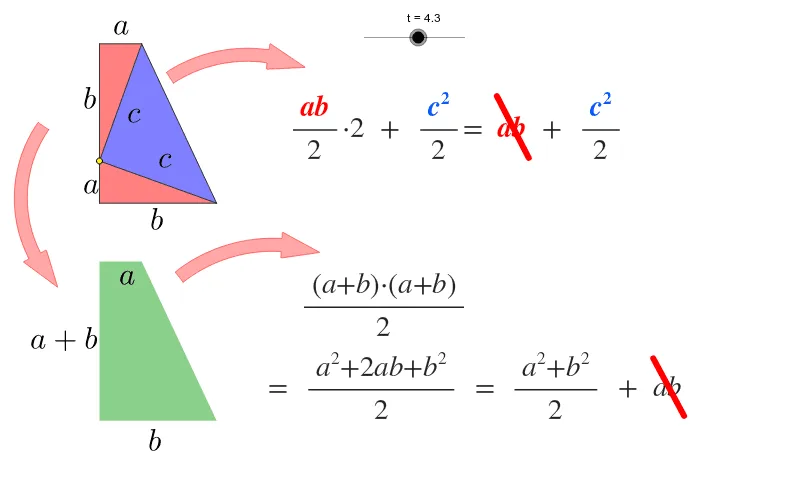
This example demonstrates the Pythagorean relationship through a constructed geometric configuration that uses isosceles triangles and tangent-line interpretations to visually link angles, tangents, and side-length relations. The key mathematics includes the Pythagorean Theorem (a square-length relation among the sides of a right triangle), the geometric meaning of the tangent function, and how isosceles-triangle symmetry supports consistent angle/side correspondence. Construction-wise, it relies on GeoGebra primitives such as Point (defining construction vertices like O, A, B, C, D and additional auxiliary points), Segment (connecting relevant points to form sides and supporting lines), Polygon (building multiple triangle/region outlines like poly1–poly4), and arrow2 (adding directional markers/annotations for the tangent or corresponding segments). With labeled objects (e.g., pic1/pic2 and text1) the diagram emphasizes the mapping from trigonometric/tangent features to the theorem’s measurable length relations. Suitable for middle to high school geometry lessons, theorem visualization in classrooms, and instruction that connects trigonometry (tangent) with classical geometry.
Loading the math board and drawing, please wait…