
Geometric Construction and Verification of Pythagoras’ Theorem
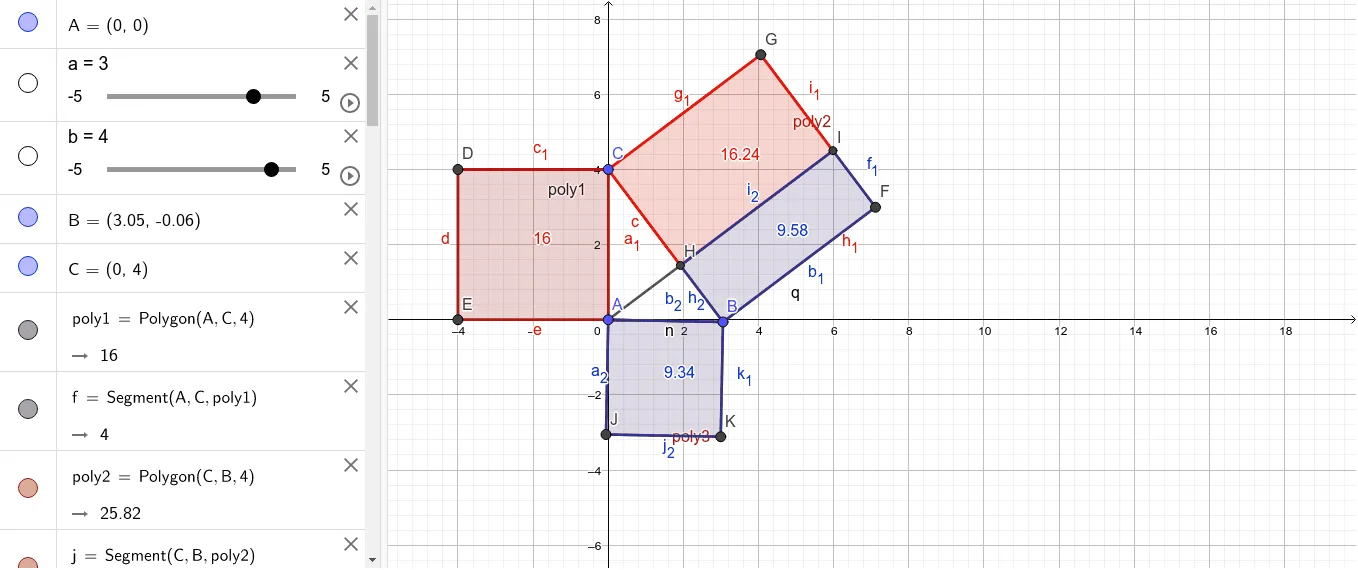
This example demonstrates, via dynamic geometry, the key relationship in a right triangle between the legs and the hypotenuse, visually supporting the verification of Pythagoras’ theorem. It centers on core concepts such as right triangles, the square relationship a^2 + b^2 = c^2 (often shown using square/area blocks), segment geometry, and the use of perpendicular constructions to enforce the right angle. Construction-wise, the GeoGebra command set indicated by the construction summary includes Polygon (to create square/area-shaped regions or polygonal visual aids), Segment (to define triangle edges), OrthogonalLine (to construct perpendicular lines that guarantee the right angle), and Intersect (to locate vertices and key points through intersections). The presence of multiple polygon objects (e.g., poly1, poly2, poly3) and function-related objects (e.g., f, g, h, i, etc., including a tangent-related element) supports a richer interactive explanation of how the geometry enforces the theorem. Suitable for middle and high school instruction, proof/verification activities, and hands-on geometry visualization.
Loading the math board and drawing, please wait…