
Pythagoras's Tree
Loading the math board and drawing, please wait…
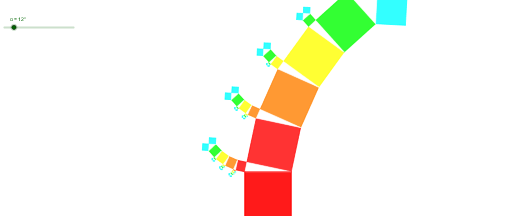
This example demonstrates the construction and growth process of Pythagoras's Tree, a fractal geometry figure. Core mathematical concepts include the Pythagorean theorem, polygon construction, matrix transformations, and trigonometry. The construction leverages commands like Polygon and objects such as A, B, poly1, f, g, h, i, C, D, q1, q2, t1, α, E, q3, q4, t2, F, H, I, J, K, q5, q6, t3, L, M, N, O, P, q7, q8, t4, Q, R, S, T, U, q9, q10 for complex geometric transformations. It is suitable for high school and above students to understand fractal geometry, matrix transformations, and dynamic geometry drawing.
GeoGebra Commands & Parameters
Polygon(A, B, 4) → poly1, f, g, h, i, C, Dpytha(D, C, α) → E, q3, q4, t2, F, H, I, Jpytha(E, J, α) → K, q5, q6, t3, L, M, N, Opytha(I, H, α) → P, q7, q8, t4, Q, R, S, Tpytha(K, O, α) → U, q9, q10, t5, V, W, Z, A_1pytha(N, M, α) → B_1, q11, q12, t6, C_1, D_1, E_1, F_1pytha(P, T, α) → G_1, q13, q14, t7, H_1, I_1, J_1, K_1pytha(S, R, α) → L_1, q15, q16, t8, M_1, N_1, O_1, P_1pytha(U, A_1, α) → G, q17, q18, t9, Q_1, R_1, S_1, T_1pytha(Z, W, α) → U_1, q19, q20, t10, V_1, W_1, Z_1, A_2pytha(B_1, F_1, α) → B_2, q21, q22, t11, C_2, D_2, E_2, F_2pytha(E_1, D_1, α) → G_2, q23, q24, t12, H_2, I_2, J_2, K_2pytha(G_1, K_1, α) → L_2, q25, q26, t13, M_2, N_2, O_2, P_2pytha(J_1, I_1, α) → Q_2, q27, q28, t14, R_2, S_2, T_2, U_2pytha(L_1, P_1, α) → V_2, q29, q30, t15, W_2, Z_2, A_3, B_3pytha(O_1, N_1, α) → C_3, q31, q32, t16, D_3, E_3, F_3, G_3pytha(V_2, B_3, 45°) → H_3, q33, q34, t17, I_3, J_3, K_3, L_3pytha(A_3, Z_2, 45°) → M_3, q35, q36, t18, N_3, O_3, P_3, Q_3pytha(C_3, G_3, 45°) → R_3, q37, q38, t19, S_3, T_3, U_3, V_3pytha(F_3, E_3, 45°) → W_3, q39, q40, t20, Z_3, A_4, B_4, C_4pytha(G, T_1, 45°) → D_4, q41, q42, t21, E_4, F_4, G_4, H_4pytha(S_1, R_1, 45°) → I_4, q43, q44, t22, J_4, K_4, L_4, M_4pytha(U_1, A_2, 45°) → N_4, q45, q46, t23, O_4, P_4, Q_4, R_4pytha(Z_1, W_1, 45°) → S_4, q47, q48, t24, T_4, U_4, V_4, W_4pytha(B_2, F_2, 45°) → Z_4, q49, q50, t25, A_5, B_5, C_5, D_5pytha(E_2, D_2, 45°) → E_5, q51, q52, t26, F_5, G_5, H_5, I_5pytha(G_2, K_2, 45°) → J_5, q53, q54, t27, K_5, L_5, M_5, N_5pytha(T_2, S_2, 45°) → T_5, q57, q58, t29, U_5, V_5, W_5, Z_5pytha(Q_2, U_2, 45°) → A_6, q59, q60, t30, B_6, C_6, D_6, E_6pytha(O_2, N_2, 45°) → F_6, q61, q62, t31, G_6, H_6, I_6, J_6pytha(L_2, P_2, 45°) → K_6, q63, q64, t32, L_6, M_6, N_6, O_6pytha(J_2, I_2, 45°) → O_5, q55, q56, t28, P_5, Q_5, R_5, S_5
AI Drawing Prompt Reference
Draw a fractal tree made of multiple right triangles, where each triangle's right angle side coincides with the hypotenuse of the previous triangle, with a rotation of 45 degrees. Start by drawing a right triangle, then continue to draw new right triangles from the right angle vertex of the previous triangle, rotating 45 degrees each time, until a complex fractal structure is formed.
The prompt above was compiled from the original drawing commands and is for reference only.