
Pyramids in Prism by John Golden
Loading the math board and drawing, please wait…
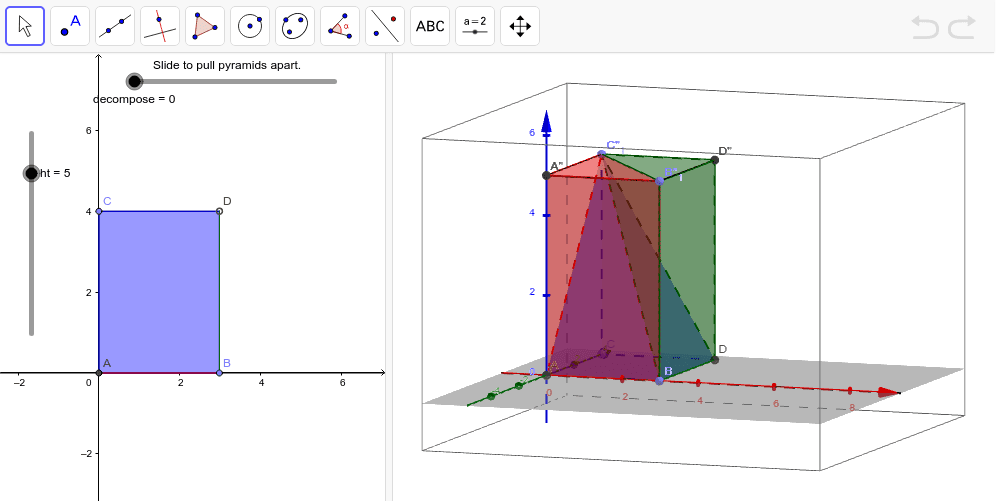
This example demonstrates how to carve up a rectangular prism into three rectangular pyramids. When the prism is a cube, the pyramids are obviously congruent. This activity helps explore volume, special points, and spatial geometry. Key math concepts include volume calculation, geometric dissection, and spatial visualization. Construction highlights the use of GeoGebra commands like Intersect, Point, Translate, Segment, Pyramid, Rotate, and Line. Suitable for high school solid geometry and calculus, exploring properties and volume relationships of spatial geometric bodies.
GeoGebra Commands & Parameters
Intersect(xAxis, yAxis) → APoint(Ray[A, A + (1, 0)]) → BPoint(Ray[A, A + (0, 1)]) → CTranslate(A, Vector[(0, 0, ht)]) → A'Translate(B, Vector[(0, 0, ht)]) → B'Translate(C, Vector[(0, 0, ht)]) → C'Translate(D, Vector[(0, 0, ht)]) → D'Segment(A, A') → aSegment(B, B') → bSegment(C, C') → cSegment(D, D') → dSegment(A, B) → eSegment(D, C) → fSegment(B, D) → gSegment(C, A) → hSegment(A', B') → iSegment(B', D') → jSegment(D', C') → kSegment(C', A') → lPyramid(A, B, B', A', C') → m, faceAA'B'B, edgeAC'_1, edgeBC'_1, edgeB'C'_1, edgeA'C', faceABC'_1, faceBB'C'_1, faceA'B'C', faceAA'C', edgeAB_1, edgeBB'_1, edgeA'B', edgeAA'Pyramid(A, B, D, C, C') → n, faceABDC, edgeAC', edgeBC'_2, edgeC'D_1, edgeCC', faceABC', faceBC'D_1, faceCC'D, faceACC', edgeAB_2, edgeBD_1, edgeCD, edgeACPyramid(B, D, D', B', C') → o, faceBB'D'D, edgeBC', edgeC'D, edgeC'D', edgeB'C', faceBC'D, faceC'DD', faceB'C'D', faceBB'C', edgeBD_2, edgeDD', edgeB'D', edgeBB'RotateRotateLine(A, B) → qRotateRotateRotate(A', ((decompose * 90))°, A, Vector[A, B]) → A''Rotate(B', ((decompose * 90))°, A, Vector[A, B]) → B''Rotate(C', ((decompose * 90))°, A, Vector[A, B]) → C''Pyramid(A, B, B'', A'', C'') → r, faceAA''B''B, edgeAC'', edgeBC'', edgeB''C'', edgeA''C'', faceABC'', faceBB''C'', faceA''B''C'', faceAA''C'', edgeAB, edgeBB'', edgeA''B'', edgeAA''Rotate(B', ((decompose * 90))°, B, Vector[B, D]) → B''_1Rotate(D', ((decompose * 90))°, B, Vector[B, D]) → D''Rotate(C', ((decompose * 90))°, B, Vector[B, D]) → C''_1Pyramid(B, D, D'', B''_1, C''_1) → s, face5, edge2, edge3, edge6, edge5, face1, face3, face4, face2, edgeBD, edgeDD'', edge4, edge1
AI Drawing Prompt Reference
Draw a rectangular prism and divide it into three square pyramids. Start by creating a rectangular prism, then use the vertices A, B, C, D and their corresponding height points A', B', C', D' to draw four vertical segments. Next, construct three square pyramids using these segments and vertices, with bases at vertices A, B, and D, and apex at C'. Finally, use rotation to adjust the pyramids' positions for a more立体的视觉效果。
The prompt above was compiled from the original drawing commands and is for reference only.