
Proving the Pythagorean Theorem with Geometric Rearrangement (GeoGebra)
Loading the math board and drawing, please wait…
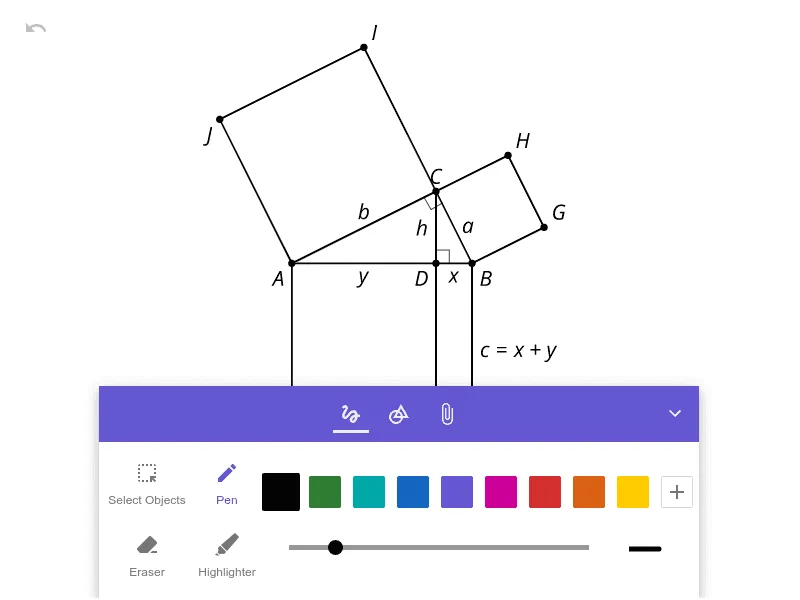
This GeoGebra practice demonstrates a geometry-based proof of the Pythagorean Theorem by rearranging and comparing areas formed from a right triangle. It focuses on key concepts such as right triangles, the correspondence between squared side lengths and areas, and constructing an equality via geometric decomposition (puzzle-style rearrangement). From the construction summary indicating the main graphic object (pic1), the workflow is to first define the right triangle geometry, then construct auxiliary shapes (typically squares or area regions) whose sizes relate to a², b², and c², and finally use an area-matching/rearrangement argument to connect the two expressions and conclude a² + b² = c². Suitable for middle and high school geometry lessons, proof practice, and exploratory math learning.
AI Drawing Prompt Reference
Create a geometry-based rearrangement diagram for proving the Pythagorean Theorem. Construct a right triangle on the plane with its two legs perpendicular and its hypotenuse identified. Around each side, build area regions whose sizes correspond to the squares of the side lengths—typically by using squares on the legs and on the hypotenuse, or by decomposing those squares into puzzle-like pieces. Then rearrange the pieces associated with the two leg-squares and compare them with the hypotenuse-square region, highlighting that the reassembled areas match in size and correspondence of the decomposition. Organize the picture clearly to emphasize right-triangle structure and the area-matching argument.
The prompt above was compiled from the original drawing commands and is for reference only.