
Properties of Similar Triangles
Loading the math board and drawing, please wait…
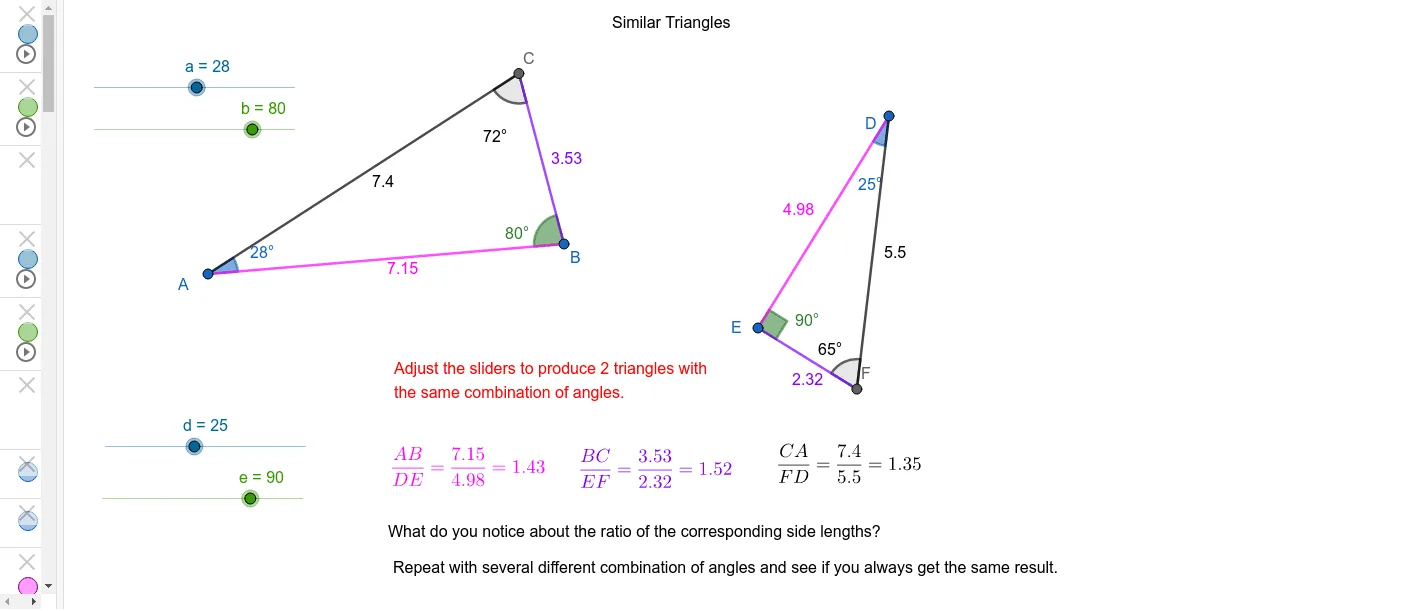
This GeoGebra example demonstrates the fundamental properties of similar triangles through dynamic geometric construction, showing that corresponding angles are equal and corresponding sides are proportional. The core mathematical concepts include similarity ratio, corresponding sides and angles, and criteria for triangle similarity. The construction uses GeoGebra commands: Rotate to create similar triangles, Angle tool to mark corresponding angles, Segment to draw triangle sides, Ray to extend lines, Intersect to find intersection points, and text tools to display angle values. Suitable for middle school to high school mathematics curricula, this example helps students understand similarity concepts, master criteria and properties of similar triangles, and develop geometric intuition and dynamic observation skills.
GeoGebra Commands & Parameters
Segment(A, B) → gRotate(B, a°, A) → B'Angle(B, A, B') → αRay(A, B') → hRotate(B, (-(b°)), A) → B'_1Rotate(A, (-(b°)), B) → A'Angle(A', B, A) → βRay(B, A') → iIntersect(h, i) → CAngle(A, C, B) → γSegment(A, C) → jSegment(C, B) → kSegment(D, E) → lRotate(E, d°, D) → E'Angle(E, D, E') → δRay(D, E') → mRotate(D, (-(e°)), E) → D'Angle(D', E, D) → εRay(E, D') → nIntersect(m, n) → FSegment(D, F) → pSegment(F, E) → qAngle(D, F, E) → ζ
AI Drawing Prompt Reference
Draw two similar triangles ABC and DEF. First, draw side AB of triangle ABC. Then, rotate point B around point A to get point B', and use the angle tool to measure angle BAC and label it as α. Next, draw ray AB'. Rotate point A around point B to get point A', and use the angle tool to measure angle BA'C and label it as β. Draw ray A'B. The two rays intersect at point C. Connect AC and BC. Then, draw side DE of triangle DEF. Rotate point E around point D to get point E', and use the angle tool to measure angle EDF and label it as δ. Draw ray DE'. Rotate point D around point E to get point D', and use the angle tool to measure angle ED'F and label it as ε. Draw ray E'D. The two rays intersect at point F. Connect DF and EF.
The prompt above was compiled from the original drawing commands and is for reference only.