
Properties of a Rhombus by Rosalie83
Loading the math board and drawing, please wait…
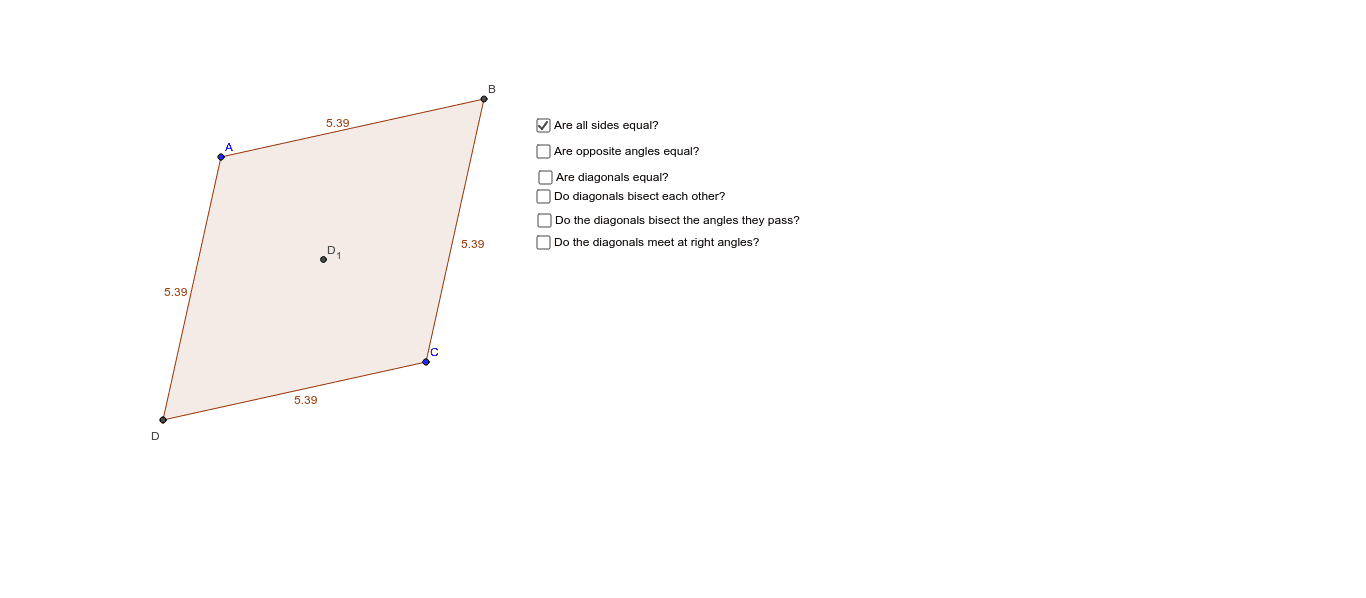
This applet allows you to change the size and shape of a rhombus by moving point A, helping you discover its properties. Key mathematical concepts include: diagonals of a rhombus are perpendicular and bisect each other, opposite sides are parallel and equal, and opposite angles are equal. The construction uses GeoGebra commands such as Intersect, Line, Segment, Mirror, Polygon, and Angle. Suitable for middle school and above students learning geometric construction.
GeoGebra Commands & Parameters
Intersect(xAxis, yAxis) → DLine(D, A) → aSegment(D, A) → bLine(D, C_1) → cMirror(yAxis, b) → yAxis'Segment(D, A) → dMirror(D, c) → A'Mirror(A, c) → CSegment(A', C) → d'Line(C, A) → ePolygon(A, D, C) → poly1, b', b_1, a_1Mirror(A, a_1) → B'_1Mirror(D, a_1) → BMirror(C, a_1) → B''Polygon(B'_1, B, B'') → poly1', b'', b'_1, a'_1Polygon(D, A, C_1, C) → poly2, a_2, b_2, c_1, b'_2Polygon(A, D, C, B) → poly3, b_3, a_3, b'_3, a'_2Polygon(D, A, B, C) → poly4, a_4, b_4, a'_3, b'_4Angle(C, D, A) → αAngle(D, A, B) → βAngle(A, B, C) → γAngle(B, C, D) → δSegment(D, B) → hSegment(A, C) → iIntersect(h, i) → D_1Segment(D, D_1) → kSegment(D_1, B) → lSegment(D_1, A) → mSegment(D_1, C) → nAngle(D_1, D, A) → εAngle(D, A, D_1) → ζAngle(D_1, A, B) → ηAngle(A, B, D_1) → θAngle(D_1, B, C) → ιAngle(B, C, D_1) → κAngle(D_1, C, D) → λAngle(C, D, D_1) → μAngle(A, D_1, D) → νAngle(D, D_1, C) → ξAngle(C, D_1, B) → οAngle(B, D_1, A) → ρ
AI Drawing Prompt Reference
Draw a rhombus and change its size and shape by dragging point A to explore its properties, such as perpendicular and bisecting diagonals, parallel and equal opposite sides, and equal opposite angles. Start by drawing point D at the intersection of the x-axis and y-axis, then draw a line a parallel to the x-axis through D, followed by line segment b. Use mirroring to create line segment d and point A', and construct the rhombus using these segments and points. Finally, measure the angles to verify the properties of the rhombus.
The prompt above was compiled from the original drawing commands and is for reference only.