
Proof that Perpendicular Bisectors of Segments Meet at One Point
Loading the math board and drawing, please wait…
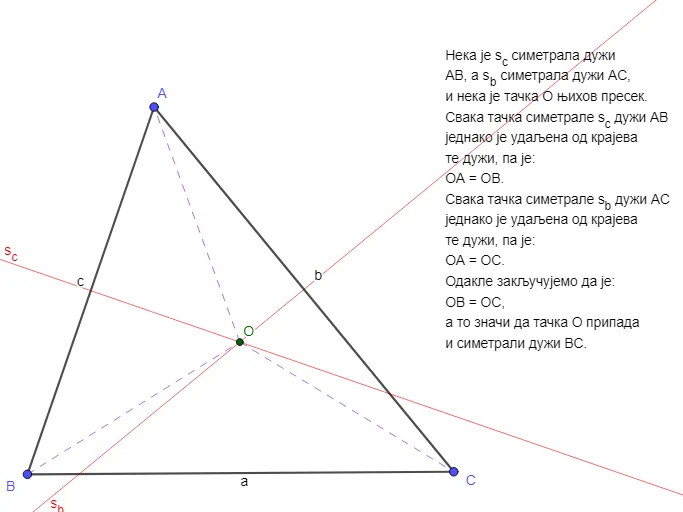
This example demonstrates a classic geometric proof: the perpendicular bisector of a segment is the locus of points equidistant from the segment’s endpoints, and the perpendicular bisectors of two segments (constructed from triangle vertices) intersect at a single point where the relevant distances are equal. The key concepts include perpendicular bisector properties, equidistance (distance-equality) reasoning, and the role of triangle structure in defining an “equidistant center.” Construction in GeoGebra uses Segment to create the given points/segments (e.g., A, B, C and related segments), LineBisector to construct the perpendicular bisectors (e.g., s_c, s_b), and Intersect to compute their intersection point (e.g., O). The resulting configuration supports proving that the intersection point satisfies the equidistance conditions. Suitable for secondary school geometry instruction, teacher demonstrations, and students practicing formal proof and geometry constructions.
GeoGebra Commands & Parameters
Segment(A, B) → cSegment(B, C) → aSegment(C, A) → bLineBisector(B, A) → s_cLineBisector(A, C) → s_bIntersect(s_c, s_b) → OSegment(B, O) → kSegment(O, A) → lSegment(O, C) → m
AI Drawing Prompt Reference
Draw a triangle and construct the perpendicular bisectors of two of its sides. Observe the intersection point of these bisectors. Then, draw line segments from the intersection point to each vertex of the triangle to illustrate the equidistant properties and the concept of the triangle's incenter.
The prompt above was compiled from the original drawing commands and is for reference only.