
Proof of Two Times the Squares of Two Numbers with a Difference of One Equals On
Loading the math board and drawing, please wait…
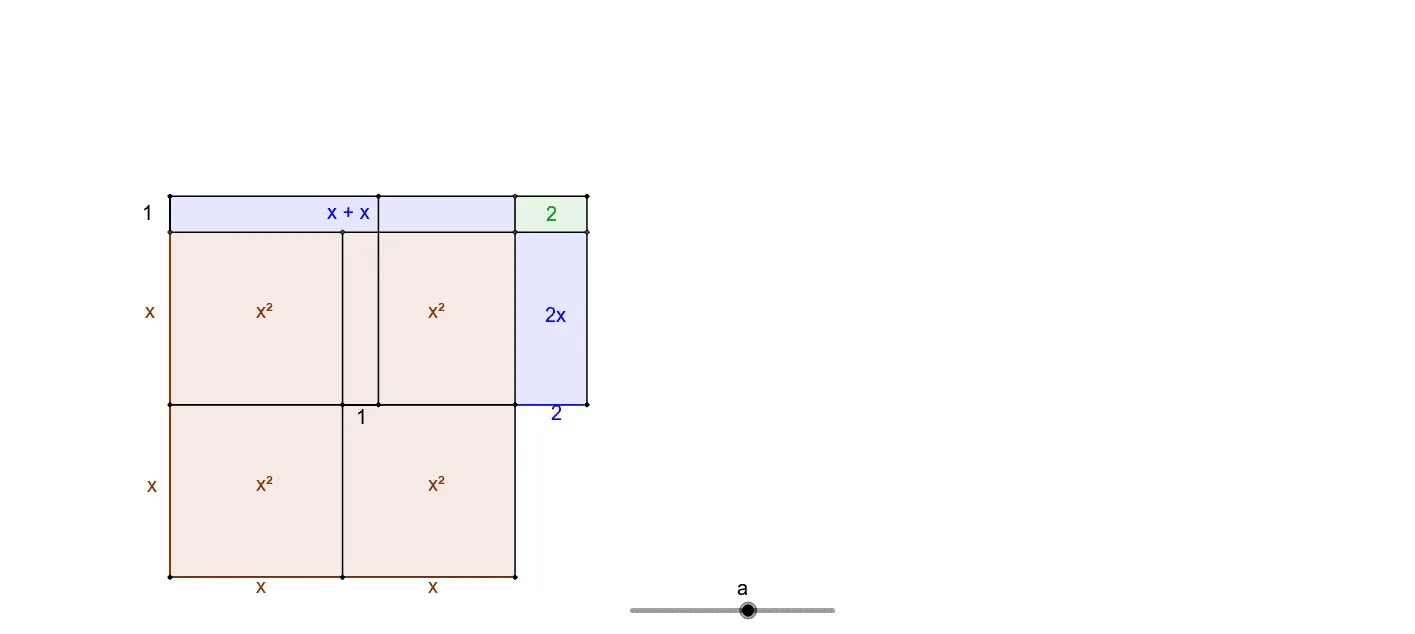
This example demonstrates the geometric proof of the algebraic identity that two times the squares of two numbers with a difference of one is equal to one plus the sum of those two numbers squared. It involves core mathematical concepts such as algebraic identity proof, square operations, and algebraic manipulation. The construction uses GeoGebra commands/objects like Line, Point, Segment, OrthogonalLine, Circle, Intersect, and Polygon. It is suitable for high school students to understand algebraic identities and their geometric interpretations, as well as for math competition preparation.
GeoGebra Commands & Parameters
Line(A, xAxis) → fPoint(Circle[A, a]) → BSegment(A, B) → gOrthogonalLine(A, f) → hCircle(A, B) → cIntersect(c, h, 2) → COrthogonalLine(B, f) → iOrthogonalLine(C, h) → jIntersect(i, j) → DPoint(Circle[B, a]) → ESegment(B, E) → kOrthogonalLine(E, f) → lIntersect(j, l) → FPoint(Circle[C, a + 1]) → GSegment(C, G) → mCircle(C, G) → dIntersect(d, h, 2) → HOrthogonalLine(G, j) → nOrthogonalLine(H, n) → pPoint(Circle[G, a + 1]) → ISegment(G, I) → qOrthogonalLine(I, j) → rIntersect(p, r) → JIntersect(n, p) → KSegment(A, B) → sSegment(B, D) → tSegment(D, C) → bSegment(C, A) → eSegment(B, E) → f_1Segment(E, F) → g_1Segment(F, D) → h_1Segment(C, H) → i_1Segment(H, K) → j_1Segment(K, G) → k_1Segment(K, J) → l_1Segment(J, I) → m_1Circle(C, D) → c_1Intersect(c_1, i_1) → L,OrthogonalLine(L, i_1) → n_1Intersect(i, n_1) → MIntersect(l, n_1) → NSegment(D, M) → p_1Segment(M, L) → q_1Segment(M, N) → r_1Segment(N, F) → s_1Intersect(n_1, m_1) → OIntersect(l, l_1) → PSegment(N, P) → t_1Segment(N, O) → a_1Polygon(A, B, D, C) → poly1, a_2, b_1, d_1, c_2Polygon(B, E, F, D) → poly2, b_2, e_1, f_2, d_2Polygon(F, N, M, D) → poly3, f_3, n_2, m_2, d_3Polygon(D, C, L, M) → poly4, d_4, c_3, l_2, m_3Segment(L, H) → g_2Polygon(F, I, O, N) → poly5, f_4, i_2, o, n_3Polygon(N, L, H, P) → poly6, n_4, l_3, h_2, p_2Polygon(N, P, J, O) → poly7, n_5, p_3, j_2, o_1Segment(D, G) → k_2
AI Drawing Prompt Reference
Draw a coordinate plane with a horizontal baseline through the origin. Place a point on a circle centered at the origin with a given radius, and connect it to the origin. Construct a perpendicular line through the origin to the baseline, and intersect it with a circle centered at the origin through the first point to get a second point. From this second point, draw a line parallel to the baseline, and from the first point draw a perpendicular to the baseline; their intersection forms a rectangle. Repeat a similar construction on the other side to create a second rectangle, connecting vertices to form a larger polygon. Finally, draw a circle centered at one vertex with radius equal to an adjacent side, intersect it with a rectangle side, and add perpendicular and parallel lines to form smaller rectangles, illustrating the relationship between the sum of two squares and another square.
The prompt above was compiled from the original drawing commands and is for reference only.